|
 |
|
|
|
|
|
NEWS
14th Annual UDITOA Convention & Trade Show
February 3 - 6, 2014
You do not need to be a
member to attend the UDITOA Convention if you qualify for general membership. (This
does not apply to associate, corporate, or temporary membership.) To
see if you qualify click here. You may attend one time
only as a non-member.
_________________________________________________________________
DRIVE-IN THEATRE OWNERS FROM ACROSS THE AMERICA GATHER FOR 13TH ANNUAL UDITOA CONVENTION AND TRADE SHOW
For Immediate Release:
Date: February 13, 2013
Kissimmee, FL. — Drive-in theatre owners and operators from across the United States traveled to Florida recently to meet with industry experts to learn the latest developments in theatre technology, hospitality and operations plus share their perspective on issues facing the industry.
“As we prepare to celebrate the 80th Anniversary of the Drive-in this June, many owner/operators have begun the process of conversion to digital cinema, which will improve the experience for our customers for many years to come. We are dedicated to ensuring that drive-ins have the ability to thrive as our theatres embrace the digital world”, said John Vincent, Jr., President of the United Drive-in Theatre Owners Association (UDITOA).
Attendees were addressed by National Association of Theatre Owners (NATO) President John Fithian, senior NATO staff and the Motion Picture Association of America (MPAA) who updated the group on industry issues as well as federal and state legislative and regulatory initiatives. Also present was Todd Vradenburg, Executive Director of the Will Rogers Motion Picture Pioneers Foundation. UDITOA is a proud supporter of the important charitable medical work, education and research conducted by Will Rogers. UDITOA Board Member Frank Fisher (Hollywood Drive-In Averill Park, NY) was recognized by Will Rogers for his tireless work with the drive-in community in support of the foundation.
Valued UDITOA partners in digital projection provided technical demonstrations and practical solutions for attendees. A full range of exhibitors were on hand to showcase their new business resources, novelty and food products as well.
During the convention, filmmaker April Wright provided a private screening of her documentary “Going Attractions: The Definitive Story of the American Drive-in Movie” to theatre owners. Ms. Wright used archival footage, vintage photos and interviews to weave a story capturing the flavor, history and excitement of this uniquely American form of entertainment. Many in attendance provided interviews for this film which was widely praised for its authentic portrait of the drive-in experience. For more information visit www.goingattractions.com.
Of great importance to attendees was the announcement that Cinedigm in partnership with NATO was bringing their successful digital conversion program to Cinema Buying Group (CBG) members of the drive-in movie theatre community. CBG is a buying program of NATO for independent theatre operators in the United States and Canada.
"We are thankful for the opportunity and excited to work with such forward-thinking groups as NATO and Cinedigm," said Vincent, "We believe their innovative and generous approach to exhibitor deployment agreements means that the unique movie-going experience outdoor exhibitors offer will continue for generations to come."
_____________________________________________________________________________________________
Representing Drive-in Theatres across the United States and internationally since 1999, the United Drive-in Theatre Owners Association, Inc. (UDITOA) is the premier association promoting the welfare of owners and operators of drive-in motion picture theatres and the interests of the movie-going public. UDITOA is a 501 [c] [6] organization. Visit www.uditoa.org for more information or call 443-490-1250 to leave a voicemail message.
Drive-in Facts:
- In 1933 Richard Hollingshead built the first drive-in theatre in Camden, New Jersey. The first movie “Wives Beware” was shown there on June 6, 1933.
- Built second, and located in Orefield, Pennsylvania, UDITOA member Shankweiler's is the oldest Drive-in Movie Theatre in America, and has been in continuous operation since 1934.
- Statistics – The industry added two new theatres in the past year. There are currently 611 drive-in screens and 368 theatres in the Continental U.S. At their height, there were over 4,000 U.S. drive-ins.
- There have been a number of new-builds and reopened theatres in the last decade marking a resurgence of interest in the drive-in entertainment option.
- UDITOA has members in Canada and Australia making it a truly international association.
For more information, contact UDITOA Director of Industry Affairs, Stu Megaw at 571/277-6315 or stu.megaw@uditoa.org.
_________________________________________________________________
Going Attractions
Digital Cinema Report
February 23, 2013
For most of the past decade April Wright has been actively writing, producing and directing independent films. One of her most recent efforts, and possibly the one nearest and dearest to her heart is her feature-length documentary Going Attractions: The Definitive Story of the American Drive-In Movie. For her as a child growing up in Northern Illinois near the Wisconsin border it was one of the rites of summer to go to the local drive-in on a summer evening. “Going to the drive-in is such a distinct memory for everyone who’s ever done it,” she says. “It’s not just about the movies, it’s about having an experience with the people you’re with.” In addition to the movies she saw there and the memories of summer nights that she shared with friends and family, she was also a fan of large architectural structures such as the Eiffel Tower and was drawn to the massive drive-in screen towers themselves. That included abandoned drive-ins as well she says adding, “I often wondered what they must have looked like in their heyday.” She says that when she first thought about the idea of doing a documentary there were about 1,000 drive-in theatres left in the country. By 2005, the year that she began her first serious work on the movie that number had dropped to 500. She told herself, “I better get out on the road before they’re all gone.” So she did and earlier this month she screened a rough cut of her movie at the annual United Drive-In Theatre Owners Association convention.
In time, Wright went to every single state (except Alaska, which has no drive-ins) and she filmed almost 500 locations, including several interesting long-abandoned drive-ins. She was determined, in her words “to tell the definitive story.” She laughs softly with more than a hint of irony when she says that many of the abandoned drive-in theatres she sought out are now WalMarts.
According to the UDITOA, as of July 30, 2012 there were 368 drive-ins and 611 screens in the United States and Puerto Rico. This is an improvement over the last time the numbers were taken in December 2011 and the totals were 366 theatres and 606 screens. At their convention, which was held in Kissimmee, Florida February 4-7, a new program was announced to help that growth trend continue. Working with their digital theatre conversion program, the Cinema Buying Group, Cinedigm and NATO unveiled a new exhibitor deployment agreement
"Traditional movie theatres across the nation have embraced the many benefits of digital cinema,” said John Fithian, president of NATO. “Cinedigm and NATO’s collaborative efforts have played a significant role in that transition and we are thrilled to partner with Cinedigm again to bring drive-ins into the digital age.”
The vast majority of drive-in theatres are independent, owner operated small businesses (the largest drive-in theatre chain totals eight sites) and most operate seasonally, usually around 110 days per year or less. Drive-in screen size and required illumination is on the outer edge of technical capabilities of projection, further complicating the conversion task. As a result, only about 10 percent of drive-in exhibitors have installed digital projectors for their large outdoor screens.
“As someone who grew up going to drive-ins, I’m thrilled that we are in the position to usher them into the digital age,” said Alison Choppelas, vice president of Cinedigm’s Digital Cinema Group. “By providing drive-in theatres digital content, including studio feature films, indie films, concerts and cultural events, this important piece of Americana will be an even more engaging gathering spot for the communities they serve.”
In addition to a new exhibitor deployment agreement, Cinedigm/NATO/UDITOA have taken a number of steps to address the outdoor deployment issue, including securing exceptions to the Digital Cinema Initiatives specifications applicable to drive-in theatres, such as relaxed sound, brightness, and masking requirements.
“We are thankful for the opportunity and excited to work with such forward-thinking companies as NATO and Cinedigm,” said John Vincent, Jr., UDITOA's president. "We believe their innovative and generous approach to exhibitor deployment agreements means that the unique movie-going experience outdoor exhibitors offer will continue for generations to come."
April Wright’s screening of an 85-minute rough cut of her documentary was a highlight of the event. Not surprisingly, Wright says the movie was well received. The drive-in owners who attended the event appreciated her documentary perhaps more than any other single audience ever could because they understand the realities of their business better than anyone.
Wright says that half of the attendees she met have either already converted to digital or have made the commitment to do so. Drive-ins, especially in the North, have always faced the twin challenges of a seasonal business situated on large chunks of real estate that might be more productive put to other uses. These have been joined by a third one. “The convergence to digital is a big challenge,” Wright says.
Of the many drive-ins that Wright has seen and recorded she understandably has a few favorites. One is the Admiral Twin in Tulsa, Oklahoma. At one time its nine-story tall tower was the tallest wooden structure in the country. The theatre was featured in Francis Ford Coppola’s 1983 film The Outsiders. Wright filmed the theatre is 2009 and a year later it burned to the ground. “It was just heartbreaking when it burned,” Wright says. “Once the fire was set it was consumed in just twenty minutes.”
In a story that’s being repeated in places across the country, the people of the community took it upon themselves to raise the funds to rebuild their local drive-in and the Admiral Twin was restored and opened for business again last summer, this time with digital cinema technology.
Another favorite of Wright’s is the Circle Drive-In in Waco, Texas. Part of what drew her to it in the first place is the large mural of a bear that graces the back of the screen. There is also an anomaly about it that appeals to her. Rather than add wings to the original screen to accommodate Cinemascope movies, the owners built a second, wider screen directly in front of the original. “And yet,” she says, “the original is the one that’s still standing.”
Wright shot most of the movie herself, using a crew only when she interviewed someone on screen. A Panasonic DVX 100B was her main camera. When she interviewed Roger Corman her crew shot in high definition with a Sony EX. Following that she had the movie UpRezzed to HD. “I edited much of it myself, predominantly on Final Cut Pro but I also had several other editors help, especially in the final pass,” she says. “The online UpRez edit was done at Modern Video Film in Burbank.” She still needs to complete a final color correction and sound mix.
Wright is optimistic about the future for drive-ins. For one thing, she says, and as the UDITOA numbers show, both the number of drive-in movie theatres and the number of drive-in screens are actually on the rise. “I believe new people will enter the market as used digital equipment becomes available,” Wright says.
Article Link
_________________________________________________________________
KwQC News
New Drive-In Could Come to Blue Grass
January 17, 2013
Amber O'Brien
Many in the QCA have been waiting *years for another Drive-In movie theater. In 2008, plans were made for a drive in theater to open up in Davenport but that never happened. Now, those owners are working to bring the big screen to Blue Grass, IA.
Owners want to put in the West end of Blue Grass, just past the fire department on Mayne Street. Randy Lorenz and his wife have 9 acres of land that they're hoping to bring the big screen too. Currently, the land is empty but by spring the owners of this property say it's not going to look like that at all. That's if anything goes as planned.
Back in 2008, he worked to develop "Reel-To-Reel" -- but he had problems with the county. By the time they got the project approved, the land to get to the property had been sold. So that sent them searching for a new place to put it.
When looking for new property, the owners had to consider the Maquoketa drive-in. Randy Lorenz says he wanted something closer to davenport and the QuadC so people aren't on the roads after a late show.
"In Maquoketa you have to drive 45 minutes there, drive 45 minutes home. At midnight you're the one awake. We want to open a drive-in because it's a family oriented affair, you can bring the kids, the neighbors, everybody can relax and have fun. When you go to a regular in-door theater you have to be quiet, you can't have your phone on," said Lorenz.
He tells us what's next in the process bringing the theater to blue grass.
"We have to go through planning and zoning and get everything approved through them with engineering. In the Spring, as soon as the ground is ready, we'll get the dirt moved and the building built. Hopefully by early summer/ mid summer we'll be ready to open the gates to our first guests," said Randy Lorenz.
Article Link
_________________________________________________________________
China Daily
That Outdoor Feeling
December 14, 2012
Chen Yingqun
Drive-in theaters are capturing the Chinese psyche with a sudden surge in audience numbers and new drive-ins after a quiet period following their first appearance in Beijing in 1998. Provided to China Daily
Chinese Audiences no longer need envy Americans watching movies from the comfort of their cars
Immortalized in film, the drive-in movie theater is as American as Mickey Mouse and Superman.
But if several businessmen have their way, this very American form of entertainment will become as Chinese as a kung fu flick.
The first drive-in in China, Beijing Maple Drive-in Theater, opened in 1998, and was the idea of Wang Qishun, who lived in the US for two years.
"I love cars and movies," he says. "I think the combination of both is fantastic. So when I came back to China I decided to bring this cultural phenomenon back with me." Over the following decade about 10 drive-in theaters opened in big cities across China, but they failed to catch on and some folded, says Yang Shuting, an analyst with EntGroup Consulting Group, an entertainment industry consultancy in Beijing.
However, this year the drive-in appears to have captured the Chinese psyche with a sudden surge in audience numbers and new drive-ins; at least 15 theaters have opened since January, and more are planned, Yang says.
Among them is Tongxing Drive-in Cinema in Jiujiang, Jiangxi province, which opened on Nov 28 and is said to have cost about 720,000 yuan ($115,547; 89,240 euros) to set up. It has one outdoor screen and can take up to 60 cars.
Tongxing's founder, Qin Tian, decided to open the theater after visiting another drive-in and being impressed by the experience. He later found that most of his friends did not know there were drive-in cinemas in China, but were interested in trying one out.
"Almost all my friends think it is romantic and fashionable to watch movies outdoors in their own cars," he says. "You don't need to worry about bothering anyone else when you eat, talk or even smoke in your own car. When the movie ends, all the drivers hit their horns together. It's amazing."
Yang says the sudden success of drive-ins is being helped along by their novelty factor, government support for cultural industries, China's growing movie industry and a developing car culture.
"The government has emphasized the development of the cultural industry and will make great efforts to help promote it, which makes many want to invest in cultural businesses," she says. "The rapid growth in both the car and movie industries makes the drive-in theater business a reasonable and promising field."
The Ministry of Public Security says there were 110 million cars in China by the end of June, 75.62 percent of them privately owned.
In the movie industry, the domestic box-office for the first 10 months of this year was 12.95 billion yuan, representing year-on-year growth of about 26 percent, EntGroup says. Box-office for the whole year is forecast to be 18 billion yuan.
Yang says it costs about 500,000 yuan for equipment to open a drive-in cinema with one outdoor screen, which she considers a relatively small investment.
However, Wang with the Beijing Maple Drive-in Theater, says there is far more for opening a drive-in than finding a vacant space and setting up a screen.
After 14 years' development, Wang's cinema is now the biggest drive-in in China, and is widely considered a success story among industry insiders and audiences alike. It has an area of about 6,600 square meters for about 500 cars, and has six screens showing the latest movies from home and abroad.
When Wang started the business in 1998 his friends and family were highly skeptical because few people went to the cinema regularly and even fewer considered going to a drive-in theater.
"Many friends advised me to invest in a more profitable business, such as a pub or a golf course," he says.
About the time of his launch the Chinese government listed the automobile as a pillar industry, and the movie industry was opened to private enterprise. Both factors gave his business a boost, Wang says.
"I thought as the car industry boomed other industries associated with it would boom too. I had confidence in my business."
In 2003 his business received an unexpected boost from the SARS outbreak.
"People were afraid of going to public entertainment venues, but they were happy to come to a drive-in and remain in the safety of their cars."
That was a turning point for Wang's business. Over the past five years it has enjoyed box office revenue growth of 20 to 30 percent a year, reaching 15 million yuan last year.
"This is not a high-profit business; it doesn't bring money in quickly or in large amounts. If you don't really love it, it's impossible to exist," he says. It will take him about another five years to recoup his investment, he says.
Over the years he has made significant changes to the drive-in six times, including improving the projection quality and the parking area. In 2007 the company set up a technology research team, which in 2010 put 3D technology into an outdoor screen for the first time to show the movie Avatar.
"We have made a lot of changes to get good quality sound and brightness and to create a setting in which people can enjoy a better experience, because if you don't put in a full effort, watching movies outdoors can be really bad."
Wang says his target customers own cars priced at about 100,000 yuan. It costs 100 yuan a car to enter the theater, and additional revenue comes from letting out space for events such as concerts and parties and selling food and beverages.
He has been working on a business model that can expand the drive-in cinema nationwide, he says, adding that about 200 potential investors have been approached. His aim is to open 30 directly owned drive-in cinema and 70 by franchise in five years. He believes drive-in still has at least 50 years of life.
"It will some time to finally work out the business model, in which I think the ticket income will only account for one sixth or one seventh of the whole income of the cinema."
But some customers' comments raise questions over Wang's optimism, and it is clear there is still a lot of room for improvement.
"It's a nice place for couples and families, but the visual effects cannot compare with those of indoor cinemas," says Zheng Yuting, 25, a teacher who has been to a drive-in several times.
"And if you sit in the back seat of the car you can hardly see anything."
Yang with EntGroup says most Chinese audiences are used to the comfortable seating and professional visual effects and sound effects of an indoor cinema, so a drive-in cinema remains a novelty.
Once that wears off, they make their way back to traditional cinemas.
She believes that drive-in cinema will continue to be a minority form of entertainment. Cinemas with more creative ideas will survive longer, while others will probably close, she says.
Article Link
_________________________________________________________________
NPR
The Waining Art of the Projectionist
November 10, 2012
Claire O'Neill
Do you ever look up at the tiny window at the back of the movie theater and wonder who's up there? Photographer Joseph O. Holmes has followed the flickering light to find out.
"I've always had this fascination with private work spaces," he says on the phone.
For years Holmes has photographed the places where people are most productive — be it a cluttered desk with an inspirational corkboard, or a tidy cube with a bobblehead and Post-its. His most recent project gets a bit more specific, focusing strictly on the work spaces of the people who make movies happen.
This is one of many stories about machines replacing humans, as Holmes explains: "I'm working against the clock with the whole series because a lot of these theaters are converting to digital projection — which does away with a lot of the interesting stuff in a projection room."
Holmes started the series in and around New York City and has slowly branched out to surrounding areas. Many of the traditional theaters he has visited are family-operated businesses. Some of the projectionists are cinephiles, says Holmes; a few of them are younger. But for the most part, he explains, it's a job.
"All the projectionists who are still working ... are finding less and less work," he says on the phone. "The only real reaction is that they were all worried about whether they'd find enough work."
I can't help but think of pesky little Salvatore in Cinema Paradiso, learning the ropes from Alfredo, the veteran projectionist — and I can't help but get nostalgic. Salvatore grows up in that little room under Alfredo's wing, and eventually becomes a projectionist himself. In the end, though, Alfredo tells Salvatore to leave town to chase his dreams, and to never look back with nostalgia.
Article Link
_________________________________________________________________
NBCDFW
Forth Worth Drive-In Screens Going Up
October 13, 2012
Chris Van Horne
In their heyday of the late 1950s, more than 5,000 drive-ins were across the country. Today, there are a little more than 500.
A crane and a half dozen workers on Friday installed two of the three screens at a drive-in under construction in the Trinity Uptown development just north of downtown.
Crews sent metallic slats up one by one and affixed them to a steel structure. A special paint will be applied early next week.
Elsewhere around the urban drive-in, much work remains. While a parking lot is nearby, the area is mostly dirt and is undeveloped.
The man building the screens thinks the drive-in will be like none other when it is completed in the spring.
"It's unique in that it's so close to the city, and the skyline at night is beautiful," said Jerry Selby, president of Selby Products. "You'll be able to watch the movies, and you've got some built-in romance. It's really special. I was out here the other night, and it's really something."
The owners of the Coyote Drive-In had hoped to open in May of this year. They said they were a little too optimistic and want to the project to be done right.
"They decided, based on the site, this will be the best drive-in in the entire country," said J.D. Granger, executive director of TRVA, which owns the land where the drive-in is located. "Because of that, they're truly making this their flagship operation."
Granger said the project gets the most calls to his office than anything else each week.
"People have been waiting -- not patiently," he said. "They're ready for it to open."
The drive-in will be a modern version of the '50s-era nostalgia. It will also be a sign of what's to come to the Trinity Uptown area.
TRVA has long wanted to bring projects like his to just north of downtown and south of LaGrave Field. Bridge work for the Trinity Uptown project is set to start in January, but this project is already helping grow the area.
"It has really, really driven up interest in development in this area," Granger said. "It should be a fun year in Uptown."
Selby, who has installed thousands of screens in his life, said Fort Worth won't be disappointed.
"They're going to have everything here -- plus, any of what the best drive-ins in the country have, this will be better," he said.
The drive-in will play first-run movies and could be adaptable to move the screens as the project develops around it.
Crews will put up the third screen over the weekend.
Article Link
_________________________________________________________________
The Hamilton Spectator
Carloads of Fun: Drive-Ins Thrive by Embracing Technology
September 29, 2012
Steve Arnold
Brian Allen’s business is supposed to be dying — the pundits have been saying so for 50 years
Despite those obituaries, the owner of Hamilton’s only surviving drive-in theatre has poured up to $300,000 into new digital projection equipment in the hope of squeezing another 15 years out of the Starlite Drive-in.
Allen, head of Premier Theatres, has drive-ins across Ontario and says 2012 was one of the chain’s best years ever, driven partly by almost $1 million in investments in new equipment.
“When you’re doing something no one else is doing they always think you’re nuts, but our business has been going up every year,” Allen said recently. “The demand for drive-ins never disappeared, but supply has fallen off because of the demands of real estate.”
Reinventing their business is a family tradition for the Allens — they’ve been in the movie business in one form or another since 1907, either operating movie houses or distributing films and, most recently, as operators of Ontario’s largest chain of drive-ins.
The company has strong Hamilton-area connections, in the past and today. It once owned the Tivoli Theatre on James Street North, Allen lives in Burlington and his wife, Carolyn Molot, is co-founder of the popular Bean Bar restaurant in Westdale.
“We’ve transitioned many times,” Allen quipped. “Now we’re grossing into seven figures and our trajectory is for a record year in 2012.”
The world’s first drive-in, or automobile movie theatre as is was called then, opened in 1933 in Camden, New Jersey. That venture only lasted three years, but the idea took root and grew rapidly with changes in technology, especially the in-car speaker that vastly improved audio quality.
By the 1950s the drive-in had become a mainstay of the era’s auto culture, with the number of sites across the United States peaking at 4,063 in 1958. Starting in the 1960s, and continuing through the 1980s, however, a series of body blows sent the industry into decline. These challenges included the solidification of daylight time that forced later starts during the crucial summer months while the rise of colour television, VCRs and the multiplex offered new competition.
Faced with those challenges, many sites succumbed to the lure of real estate development — a drive-in can occupy up to 12 hectares of land for which builders of strip malls and town house complexes will offer hefty premiums. That was the fate of the other three drive-ins that Hamilton used to support — the Stoney Creek on Barton Street and others on the west Mountain (Hamilton Drive-in) and near Waterdown (Clappison Drive-in).
The Stoney Creek Drive-in, by the way, was the first in Ontario. It opened in 1946 and closed in 1970.
Today, the United Drive-In Theatre Owner’s Association says there are 368 sites operating in the United States with 611 screens. The Internet site drive-ins.com estimates there are now only 56 drive-ins open in Canada including about 22 in Ontario.
In more recent years the industry has been staging a comeback of sorts as new owners update their properties for a new audience.
“First television was supposed to kill us, then the video recorder was going to kill us but people still come out,” Allen said. “People have kitchens but they still go to restaurants because they want a chance to socialize.”
Statistics Canada captured some of this revival in 2006 when it published the last of its periodic surveys of theatre attendance. The federal number crunchers reported attendance at drive-ins had risen more than 20 per cent in 2004, ending eight straight years of declines. That rise was accompanied by a 6.9 per cent drop in the average admission price. During that year five new drive-ins opened and only one closed.
Premier has been a leader in that push, pouring almost $1 million into digital projectors for its sites as well as making physical improvements.
The experience at the Starlite is typical. Premier bought the Green Mountain Road theatre in 2004, adding it to a portfolio the company owns or manages in London, Barrie, Oakville and other places. By 2007 the single aging screen was replaced with three new ones and in April of this year digital projectors were added. The theatre’s three viewing areas can accommodate at least 780 cars.
“The only way this business model works is with multiple screens,” Allen said. “There’s just not much room for an individual operator anymore.”
The same feeling applied to the move to digital projectors.
“I was a little tentative about that at first, but now I’m excited,” he added. “We had to do it because this is a generation that expects that kind of quality. We’re really debunking the myth that if you go to the drive-in you’re going to see an inferior product.”
The decision to go digital was also driven by the fact movie studios intend to stop making movies on film next year, converting to digital content. The National Association of Theatre Owners has said the cost of going digital could drive as many 20 per cent of smaller theatres and drive-ins out of business.
Allen said the move to digital quality pictures, along with the “traditional” drive-in amenities such as play areas for children, will sell the drive-in as an affordable, family-friendly night at the movies, an alternative to a $100 outing to the multiplex. At current general admission prices of $11.50 for adults and $8.99 for children under 13, a family of four would drop $41 just for admission to a single movie at SilverCity in Ancaster — before they even get near the concession stand. Prices run to more than $17 for 3-D or IMAX movies. At the drive-in, however, admission is $10 per adult and, $2 per child — $24 — and every show is a double bill that also includes a vintage cartoon.
Article Link
_________________________________________________________________
The Island News
Bonnie and Joe Barth of the Highway 21 Drive-In: Where the Stars Come Out to Play
September 27, 2012
Lanier Laney
Bonnie and Joe Barth are the rare couple who both enjoy working two jobs each.
During the day, it’s the flooring business — Bonnie works for Floor Fashion in Moss Creek Village and sells all types of wonderful flooring, carpet, tile, stone, wood, while Joe — a flooring sub-contractor who owns his own business, J & J Flooring Installation — installs carpet, vinyl, both residential and commercial flooring.
At night, they start their second job of running the Highway 21 Drive-In Movie Theatre, which they co-own and love.
Joe and Bonnie Barth of the Highway 21 Drive-In Movie Theatre.
It was kind of by accident how they got into the “movie business” here. Joe, a Wisconsin native, met Bonnie, who was from Florida, at a coed softball game in Texas. They fell in love and have been married for 16 happy years. They decided to move to Beaufort to be closer to Bonnie’s family (her brother George Shelor lives on Hilton Head).
Bonnie said, “We bought a house in Grays Hill about five minutes from the drive-in. We moved here in 1996 and went to the drive-in often. This is why we were so disappointed to see it close in 2002. Little did I know at the time that Joe would decide to buy and reopen it.”
Fortunately, one of them had some experience working at a drive-in theater. Bonnie grew up in Palm Beach County, Florida, and her first real job was at the Beach Drive-In Movie Theatre in West Palm Beach. “So she knew how to make the popcorn already,” said Joe with a laugh. Other than that, they had to learn on the job, but learn they did and for the past eight years, it has been a Beaufort favorite for families and couples on dates.
I asked Joe why he thinks people like going to a drive-in versus a regular movie theater and here are his Top 10 reasons:
1. You don’t have to fight for the arm rest.
2. You won’t have people texting or talking on their cell phones sitting near you (unless they are with you).
3. No gum stuck under the seat.
4. Concession food is reasonably priced.
5. You don’t have to look around or over the head of the really tall person sitting in front of you.
6. You control the volume.
7. Have a baby that might cry? No problem.
8. Have a dog with “separation anxiety”? We’re pet friendly.
9. You can laugh out loud without being ssshhhed.
10. And, as one of our younger patrons commented, “I get to breathe fresh air and see bats!”
Both Bonnie and Joe really love working at the drive-in “because of the many great people we meet there,” says Bonnie.
Adds Joe, “It is so refreshing to have such loyal customers who really appreciate everything we do.”
Plus they’ve had a lot of fun experiences with customers there. Says Joe, “It’s always funny when we’re asked if we show matinees,” (since you can’t show movies during daylight at a drive-in) and sometimes they have to wake up a customer when the movies are over. They often have to catch teenagers sneaking in, because they heard their parents did it “back in the day.”
“But the saddest thing,” says Bonnie, “is our military customers who get transferred and come in for their last trip to the tell us goodbye.” At least they send them off with fond memories of the happy nights they spent at the drive-in in Beaufort.
Both Bonnie and Joe agree: “Our employees and customers are like our family, we love and appreciate them very much.”
Their daughter Cara helps out at the drive-in too and she plans to marry Steven King who works with Joe — keeping the flooring and drive-in combo going into the next generation.
If you love the drive-in and want to see it continue, there is a great fundraiser this Saturday, Sept. 29, starting at 3 p.m., called The Hooligan Hoedown Classic Car Club. It will raise money for a new digital projector. The admission is $15 per person which includes the movies and gives attendees the chance to win prizes being provided by Beaufort Liquidators. There will be a Classic Car Show, pre-1980 bikes, live bands, a swap meet and vendors.
Article Link
_________________________________________________________________
The New York Times
The Sun Hasn't Set on the Drive-In
August 18, 2012
Brooks Barnes
THE citrus groves are gone. Route 66, which once pulsed through this Los Angeles suburb, is a memory. Marilyn Monroe lives on mainly through tacky gift shop trinkets.
But another 1950s-era symbol of Southern California — the drive-in movie theater — continues to thrive here.
Mission Tiki, a Polynesian-themed drive-in with four screens and room for 1,000 cars, has been packed this summer, just as it was last year. At sunset on a Saturday in early July, with the San Gabriel Mountains glowing burnt orange in the distance, children with hot dogs ran between cars, a few teenagers on dates cozied behind dashboards, and families camped out in lawn chairs.
“Got to get nachos before the new ‘Spider-Man’ starts,” said Maria Gonzalez, a 27-year-old sales clerk, following a popcorn-scented breeze toward the faux-bamboo snack bar.
Drive-ins remain an extremely fragile business. Only 368 remain in the United States, and their numbers are dwindling by two or three a year, according to the United Drive-In Theatre Owners Association. But some survivors, like Mission Tiki, appear to be chugging along just fine — a few are even gaining steam — as a more affordable option to the multiplex, where ticket prices in a big city can run $12.50 or more for adults and $9.50 or more for children (not to mention an extra $3 or so for 3-D films that the drive-ins can’t show).
Mission Tiki, reflecting prices at drive-ins nationwide, charges $7 for adults and $1 for children ages 5 to 9. Younger children are admitted free.
“Don’t forget that you can also bring your own food to a drive-in, which is what we did,” said Kristy Dahlstrom, 23, a marketing assistant, as she sat in her Ford Focus with a friend at Mission Tiki awaiting the comedy “Magic Mike.” Picking up dinner at a McDonald’s drive-through on their way “got us an entire dinner for the price of a single popcorn at the regular theaters,” she said.
DRIVE-INS are where thriftiness and a fondness for the past converge with escapist entertainment — under the stars, no less.
Soupy cheese fries are part of the deal, footballs occasionally fly past the windows and the romance in the next car can be more deserving of an R rating than the movie. And while the crackling speakers of old have been replaced by low-frequency radio transmissions, no one is expecting a state-of-the-art presentation — a good thing, considering that the headlights of late-arriving cars can end up co-starring with the characters on screen.
“Yep, we’re at the drive-in,” Ms. Dahlstrom said, as the lights of an S.U.V. momentarily merged with a shirtless Channing Tatum on the big screen.
Nostalgia, of course, helps power this corner of moviegoing. Older adults may have fond memories of sneaking in by hiding in car trunks; younger people may want to channel Danny Zuko of “Grease” (who sang of being “stranded at the drive-in”) while they still can.
“I love taking a date to a drive-in because it’s just so unexpected these days,” said Seth Hancock, 30, who frequents the Vineland theater in City of Industry, Calif. “Plus, everyone is always in a good mood at a drive-in.”
There is no publicly available box-office data for drive-ins, but West Wind, a seven-theater chain centered in California, says 2011 ticket and concession revenue was up 43 percent compared with three years ago. Frank Huttinger, the chief executive of DeAnza Land and Leisure, which owns six drive-ins, including Mission Tiki and the Starlight Six in Atlanta, said his operation had “a substantial increase in attendance” this summer, compared with last.
Both West Wind and DeAnza are in the process of installing digital projection systems at their theaters, an investment that West Wind estimates at about $2 million.
“The conversion to digital is expensive, for sure, but it also means we think there is a future,” said John Vincent Jr., president of the drive-in association and owner of the Wellfleet Drive-In on Cape Cod.
Attendance there so far this summer is “extremely encouraging,” Mr. Vincent said.
The drive-in obituary has been written repeatedly, for what seem to be good reasons. The first drive-in opened in 1933 in New Jersey, and about 4,000 were operating by the late 1950s, but a changing America found new leisure-time loves. The solidification of daylight saving time in the 1960s contributed to the drive-in’s downfall, forcing later starting times. Widespread sales of color televisions hurt, too. Later, the VCR and multiplexes — called hardtops in movie theater parlance — took a toll.
And real estate development is a continuing threat. Drive-ins can occupy 30 acres or more, and originally were often built on low-value farmland. But urban sprawl eventually caught up, with shopping mall builders in particular buying and razing the outdoor theaters.
“Every three years or so,” Mr. Huttinger said, “we are approached by developers at one of our various properties with an offer that we have to take seriously.”
The resilience of the drive-in business seems to shock even those who make a living in it.
“The truth is, we hadn’t paid a lot of attention to the drive-ins because, like a lot of people, we thought they were going away,” said Tony Maniscalco, West Wind’s vice president for marketing. West Wind was formerly part of the Century chain of traditional theaters, which was sold to Cinemark in 2006. But Cinemark did not want the drive-ins.
“We were scratching our heads asking, “What can we do with these things?’ ” Mr. Maniscalco said. “We decided to start repairing them and cleaning them up and promoting them. And we were amazed at the response.”
He added, “Suddenly, we have a business even we believe in.”
COUNT Chuck Rayes in, too. A body shop manager, Mr. Rayes, 50, came to Mission Tiki with his wife to see “Ted” and was surprised to find fresh paint and a pothole-free parking lot.
“I admit that I had to be dragged,” he said, sitting in a lawn chair. “But I’m impressed. There’s a nice feeling of community here that you don’t get many places anymore.”
His only complaint: the food was a little too good.
“I was hoping for old times’ sake to have a hamburger that had been sitting for hours under one of those warming lights,” he said.
Article Link
_________________________________________________________________
News-Press Now
Drive-In Theater to Open Soon
July 29, 2012
Eric Keith
Riley and Vickie Cooke are nearing completion of a two-year project near and dear to their hearts.
The Cooke Brothers Drive-In (Missouri) should be open by the end of the week. The drive-in theater, located at 4814 S. U.S. Highway 169, is in the final stages and waiting on last-minute permits before opening.
The Cookes purchased the property two years ago after Mr. Cooke’s brother died.
“It’s always been my family’s property,” Mr. Cooke said. “Since the 1940s, we’ve had a presence in St. Joseph.”
For years, the site was home to the family’s implement store, Cooke’s Sales and Service.
The new theater will be similar to that of the couple’s drive-in theater in Montana. There will be two screens, with a double feature on each screen.
“We’re a movie theater, so we show new movies,” Mr. Cooke said.
Yet the drive-in theater won’t be able to list which movies are playing weeks in advance. Ms. Cooke contacts Hollywood companies such as Pixar and Lionsgate on Mondays for that coming Friday. They don’t use a standard booking system.
However, Cooke’s won’t have two blockbuster hits in the double feature. One will be a blockbuster and one will be about two weeks old — but never more than six. It just isn’t feasible to have two major pictures back-to-back, Mr. Cooke said.
The Cookes have started to fight for film, now that most theaters have gone digital. “I’ll have to go digital sometime soon,” Mr. Cooke said.
It’s a major investment, but one the Cookes are willing to do since they said they are in St. Joseph for the long haul.
“We know how to do this,” he said. “We’re not rookies.”
The couple operates a successful drive-in theater and a three-screen indoor theater near Billings, Mont. They built both from the ground up.
“We’ve been in the entertainment industry for years,” Ms. Cooke said.
The pair spent 17 years in the carnival business.
“I’m a ride man,” Mr. Cooke said. “I hauled around big scrap metal and set it up.”
Toward the end of that career, the Cookes had their own complete traveling carnival. They left to start their family, and have two daughters, one of whom will be operating the St. Joseph theater while she goes to college.
Going to the drive-in is a family-friendly atmosphere that is easy on the pocketbook
“For a $20 bill, you can have fun, don’t have to get a sitter and can get cheap treats,” Mr. Cooke said.
Patrons listen to the movie via their own FM radio and can control their own volume.
Besides the movies, there’s the food and the rides. In Montana, their drive-in theater has a roller coaster. While the St. Joseph location isn’t quite ready for the extreme rides, there is a kids-size Ferris wheel and another roller ride.
The new drive-in has a full lounge area, as well as a kitchen offering treats ranging from pickles, popcorn and candy to soda and pizza. Large pizzas can be ordered and delivered to the car during the movie.
For now, the theater will be open every day of the week. After Labor Day, it will be open Fridays and Saturdays, with a possible Sunday special. The gates will open at 8 p.m., and the movies will begin as soon as it gets dark.
Back home near Billings, the Cookes have a core group of kids who have worked at their theaters for years. They’re hoping for that same relationship in St. Joseph.
Article Link
_________________________________________________________________
Drive-In Movie Theaters Popular Again
CBS News
July 14, 2012
Michelle Miller
Recently, CBS News visited the Overlook Drive-In, in business in Poughkeepsie, N.Y., since 1947, to see why drive-ins still capture our imagination.
Movie-goer Joan Benton said it's a love of movies instilled since childhood. "I've been going to the drive-in ever since I was a little kid," she said. "You went as a child, and then you went with your boyfriends when you were dating."
The Overlook Drive-In has been a film favorite for 65 years, offering everything from animated classics to big budget blockbusters, all via the great outdoors.
Another movie-goer, Danielle McAvoy said, "My husband and I both grew up in this area and came to this exact drive-in when we were kids and we remember the experience our families had and we wanted our kids to experience the same."
So McAvoy brought friends, their husbands, and their entire brood.
Another movie-goer told CBS News, "It's fun, the kids all play around. We don't have to be in the theater, it's not, you know, 'Shhhh!'"
But business isn't what it used to be. The first drive-in opened in Camden, N.J., in 1933. By 1958, at their peak, there were 4,000 nationwide.
A past-time so popular, the drive-in often made a cameo appearance on the big screen itself, in movies like "Grease" and "Twister."
These days, there are just 364 drive-ins left. But they may be staging a revival. Six new theaters will open by the end of this year, in Michigan, Indiana, Oklahoma, Texas and California.
Film historian and critic David Edelstein said he believes there's still room for the outdoor theater. "Nowadays when you go to a drive-in, it's a sense of occasion. ... Now with more and more people watching films on-demand, at home on DVDs, you need something to get them into the theater, and the drive-in nowadays has this wonderful, kind of retro feel."
It's just the thing that keeps Joan and Floyd Denton's marriage on fairy-tale footing.
Floyd Denton told CBS News, "I work a real weird shift, overnights and it's difficult - my wife works days. ... We try to make it as often as we can during the summer."
Then there are the other things drive-in theaters are known for - car liaisons.
Rich Downing has seen it all from his post as manager at the concession stand at Overlook Drive-In.
When asked what he's seen in his 12 years at the drive-in, Downing said, "What have I seen? I can't tell you some of the things I've seen, but I see a lot of happy people. They're in a good mood, they want to come out. They want to have fun."
Article Link
_________________________________________________________________
USA Today
Drive-In Theaters are Making a Comeback Across the USA
July 8, 2012
Judy Keen
Load the family in the car. Drive-in theaters are making a comeback.
New outdoor theaters are opening, and shuttered ones are being revived as people rediscover the pleasures of watching movies outdoors with no restrictions on chatting, screaming kids, cellphone use or smoking, says Kipp Sherer of drive-ins.com.
The website, which tracks and celebrates the industry, says there are 364 drive-ins in the USA, down from their peak of at least 4,000 in 1958. In 2007, there were 406. The first drive-in theater opened in Camden, N.J., in 1933.
"People love the communal experience," Sherer says.
Bart Lower and his family decided to build a drive-in, Danny Boy's in Ionia, Mich., after Google told him that more than 90,000 people in Michigan search for "drive-in movie" each month. The theater opens this month.
"It's going to be a new way to see a movie for a lot of people," Lower says.
Paul Allsup hopes to rescue the Linton Drive-in in Linton, Ind., which opened in 1948 and closed in 1999. He expects to open in late August or early September.
Elsewhere:
•Tulsa's Admiral Twin, which opened in 1951 and burned down in 2010, reopened June 15. "The community kind of rallied around us and started actually just giving us money to rebuild," co-owner Blake Smith says.
"There is definitely a resurgence of drive-ins," he says, maybe because people "are tired of the sterile environment" in multiplexes. Rising land values a few years ago "pretty much caused all the drive-ins to go away," Smith says.
•The Full Moon Drive-in opens July 20 in San Diego. "People are really connecting with nostalgia," partner David Adler says.
•Cameron Grimm and Paul Goodson have formed a foundation and plan to operate the Skyvue Drive-in in New Castle, Ind., as a non-profit. They hope to reopen it in May.
•The Blue Starlite Drive-in opened Wednesday in Austin. It can accommodate 50 cars and 100 walk-in customers; a parking lot that owner Josh Frank had been using had room for far fewer.
Sherer warns that the revival might not last long: The movie industry is switching from 35mm film to digital, and many small drive-ins can't afford digital projectors. "A lot of drive-ins most likely won't open next year," he says.
Article Link
_________________________________________________________________
China Daily
Driven to Distraction on Wheels
June 22, 2012
Li Xinzhu
A quaint form of entertainment that was dreamed up 80 years ago refuses to die, Li Xinzhu reports in Shanghai.
In an age of 3D films, DVDs and high-definition screens you could be forgiven for thinking that drive-in movie theaters had gone the way of the dinosaur. It can be happily reported that not only are drive-in movies alive and well 80 years after their birth, but that they are faring rather well in at least a few places far from their American birthplace. A drive-in theater that opened in the Pudong district of Shanghai last month has attracted a huge amount of interest and provided movie goers with a novel experience that has a distinct retro feel about it. Griffin Drive-in Theater, which covers more than 10,000 square meters, enough space for about 150 cars, is run by Beijing Griffin Film and Television Culture Media Company. Two steel truss structures hold the screen, which is about 20 meters long and 12 meters wide.
"It was a unique film watching experience," said Tang Hongjie, 28, who works for an immigrant consulting company in Shanghai, and who said he had seen drive-in theaters many times in American movies.
"So I borrow a car from my friend immediately after I heard the news."
The managers say business is brisk, particularly at weekends, with full houses being reported, particularly between 7 pm and 10 pm.
Zhu Xiaodong, 29, deputy manager, said the sheer numbers in Shanghai bode well for the theater.
"Shanghai has millions of cars and more than 20 million population. It is a great market."
In the three weeks after the theater opened on May 18, Zhu said, several minor changes were made based on the feedback from the audiences.
"Shanghai people prefer to watch movies with original soundtracks, so we replaced all dubbed versions as soon as that became clear to us."
"We expect other business partners to join us, so we will be able to have a complex commercial zone in the future."
As with other movie theaters, patrons can indulge their taste buds with food and beverages bought from a small shop or with roast lamb and beef from a barbecue stall.
The outside area of the theater is a bit shabby and muddy, especially when it rains, but Zhu said there are plans to improve the surroundings step by step.
But rain or shine, Zhu said, the theater can still provide high-quality movies. And even if it does rain, he said, all that means is that "the wipers might be a bit busy. Some young people think it feels more romantic to watch a movie in the rain."
The competition between cinemas in Shanghai is stiff because there are more than 90 cinemas in the city, Zhu said. "We could barely find a place to run another cinema, so we decided to do something different.
"If the business is good we will soon open another drive-in theater However, the land and location is crucial. We could put up a screen for 3D movies and one for iMAX 3D movies in a bigger place in he future."
Drive-in theaters were highly popular in the US, particularly in rural areas, in the 1950s and the early 1960s.
One advantage that the drive-in format has over the traditional cinema is that you can chat freely with those sharing the car with you, and you can use toilets without the embarrassment of making dozens of people stand up in the darkness to let you out.
But there are drawbacks, too. To watch a movie in a drive-in theater you need to turn on the ignition because the soundtrack needs to be picked by the car radio, and in summer or winter the air conditioning needs to be switched on.
Those drawbacks are apparently not enough to put off Zhang Peng, 33, who works for a wine dealer. "I think it is a great place to enjoy yourself," she said.
But not all are convinced of the attractions, personal or commercial, of drive-in theaters.
"We looked at opening a drive-in theater, but we shelved the plan after doing market research," said Shen Qiang, director of business operations with Shanghai Film Center, one of the big cinemas in the city.
"I don't think a drive-in theater business can work. The sound quality cannot be guaranteed with a car's audio system, and space in a car is limited."
Developing traditional cinema is still the accepted way of doing things, Shen said, adding that a new cinema from Shanghai Film Center is being built in the city's Baoshan district.
"If a drive-in theater wants to succeed, it needs to build a kind of social network to connect certain types of people. There is no way that the business can rely on individuals."
Shen said the ticket price in drive-in theaters is also prohibitive, because group-bought cinema tickets cost 35 to 50 yuan ($5.50-7.90) per person in conventional cinemas, but 150 yuan in their drive-in counterparts "Why would anyone spend more money and drive a long way to see a movie?"
An industry insider who asked to remain anonymous said the great success of Beijing Maple Drive-in Theater, said to be the first drive-in theater in China, cannot be replicated in Shanghai.
"People in Shanghai prefer a relatively comfortable environment as they watch movies. That's why a lot of money has been poured into the facilities in cinemas. People may well go to drive-in theater once or twice, but eventually they will be back sitting in a cinema."
Article Link
_________________________________________________________________
The 25 Most Unique Drive-In Movie Theaters
Complex Rides
June 20, 2012
Nina Pola
It is officially summertime, so you know what that means: the great outdoors, cook-outs, cruises, and summer lovin' (if your lucky). And what's the perfect culmination of all these awesome things?! The drive-in of course!
Richard Hollingshead Jr. first blessed us with the drive-in theater concept, opening in Camden, New Jersey during the summer of 1933. The idea caught on quick and by the 1950s it was the move to make on a Friday night, with over 4,000 to choose from across the country.
Today, they are fading relics, mostly just a thing of the past. Drive-ins provide a nostalgic experience under the stars that bring us back to the happy days with the biggest movie screens, amazing snack bars, and unbeatable admission prices. It is a movie experience unlike any other and a chance to support the endearing Mom and Pop tradition. Best of all, they are regaining popularity and making a proper comeback. Don't believe it? Check out this comprehensive list of the most unique drive-ins in existence today and go visit one near you for a quality summer night out.
The 25 Most Unique Drive-In Movie Theaters.
Click Here to Start the Story »
http://www.complex.com/rides/2012/06/th ... n-#gallery
_________________________________________________________________
Tulsa's Admiral Twin Drive-In to Reopen Next Week
World Scene
June 6, 2012
Micheal Smith
It’s time to load up the car, find the perfect parking spot and tune in for a double-feature: The Admiral Twin Drive-In resumes showing movies next week.
The iconic drive-in, a 60-year institution north of Interstate 244 and immortalized in the film version of Tulsa author S.E. Hinton’s “The Outsiders,” went up in flames in September 2010 when the all-wood, nine-story, double-sided screen tower burned to the ground.
On June 15, the Admiral Twin revives movie-watching under the stars, following new construction that includes two new screens made of modular metal panels — no wood this time — as well as new rest rooms (air-conditioned for the first time) and a new concession stand.
There are new electrical lines, new plumbing and more, and it came at a price of more than $700,000, said Blake Smith, who co-owns the drive-in with Steve Peace.
The more than $30,000 raised by fans of the “Save the Admiral Twin” effort immediately following the fire made a vital impression on bankers who financed the project, Smith said.
“More than the figure itself, that spirit really showed the (bankers) the ‘want’ from the community for this to come back to life, and that was priceless,” he said. “It made the drive-in look viable when building a drive-in is hardly the most practical business model these days.”
Smith announced the Admiral Twin’s opening date on Wednesday, the 79th anniversary of the first drive-in opening in New Jersey in 1933. Drive-ins reached the height of their popularity in the 1950s, when more than 4,000 were operating in the United States.
Today that number is fewer than 400, figures show.
The Admiral Twin opened in 1951 as The Modernaire with one screen, then changed its name the following year with the addition of a second screen. The destructive fire occurred on the final weekend of the drive-in’s 60th season.
The 11th-hour work to be done to open the drive-in next week is considerable — some concession stand equipment has yet to arrive, and new 35 mm projectors promising brighter images are expected on Monday.
Smith refers to June 15 as the start of a “soft opening,” with a grand-opening ceremony probably a couple of weeks away.
“We’re excited, and we know people have high expectations, and we may be working out a few kinks,” he said, “but we need to get open, for the sake of running the business and for the community.”
Architect Shelby Navarro of Tulsa’s ONE Architecture, who donated his services in designing the steel-paneled, open-ended screen tower that looms above the new concessions area and restrooms, marvels at the finished product.
“This is definitely not going to burn down. This structure is going to be around for a long time. I’m just so pleased that it offers that same nice form in the skyline,” said Navarro, who grew up in Verdigris and as a child always knew his location in Tulsa when he saw the landmark.
“When it burned down, there were so many people at the gate, lamenting the memories that were made there, and I made my own memories there.”
Future generations can create new drive-in memories beginning next weekend, when movies like “The Avengers” and “Rock of Ages” will be beamed onto the largest movie screens in the Southwest.
The price for a double-feature: $7 for adults, or as Smith puts it, “the best deal in town.”
“I know we’ll have a lot of people out here next week, and I hope they keep coming for this very different experience that the multiplex can never produce,” he said.
“Those cars lining up, the women who come out with their hair in rollers, the people who drive up with a couch in the bed of their pickup — that’s real Americana. It’s a real family experience, and it’s important to Tulsa.”
Smith said the drive-in’s season will depend on the weather. As a businessman, he’s hoping to extend the season to Thanksgiving, if not longer.
“Wouldn’t it be great if the weather were mild and we just had to close for January or February before reopening?” he asked.
Most Tulsans would answer in the affirmative.
Article Link
_________________________________________________________________
'The Drive-In': Get the Story about Google's latest Doodle
Popwatch
June 6, 2012
Erin Strecker
From imagination to reality — that’s Google doodler (actual official title!) Mike Dutton’s job.
Dutton has helped create those doodles you see on Google’s home screen — like one honoring Charlie Chaplin to more elaborate moving pictures such as a doodle to honor John Lennon’s 70th birthday.
Today, a new Google doodle premieres honoring the 79th anniversary of the drive-in movie theater. The first drive-in was in New Jersey, but Dutton drew inspiration from drive-ins all over the country. “[All drive-ins] have that sort of retro look,” Dutton says.
Like most young people, Dutton had never actually been to a drive-in, so he did his research before creating this doodle. “I did a lot of reading on blogs about what people missed most about drive-in theaters,” he said. ”Big cultural things set drive-ins apart. For example, no matter how long the movie was, there was always an intermission, time to stretch, get up, get a snack. Another aspect was that it was really popular for people to stow people in their trunk and sneak them into the theater. We didn’t want to endorse it, but we had two kids on the back of their parents’ truck. You see the heads pop out at the end.”
Tech: Get the latest news, photos, and more
The video has plenty of details fans of the drive-in can appreciate. From the intermission sign (spelling out “Google,” naturally) to added touches such as firefly sounds, Dutton wanted to capture the ambiance and nostalgic feel of a bygone era. “This may not be our most in-your-face doodle, but we just kind of want people to sit back and enjoy the show.”
Watch the doodle below:
http://www.youtube.com/watch?v=TV7ppqSz ... r_embedded
_________________________________________________________________
Reborn: American Drive-in Movie theatres
CNBC
June 4, 2012
Regina Hing
10 Drive-Ins Ready for the Future
Drive-in movie theaters are often thought of as relics from times gone by. But while it's true that the real estate drive-ins occupy are often more valuable than the business, many theaters are hanging tough. The past decade has even seen some new theaters built.
Make no mistake, though. The industry, like many small businesses, faces challenges. The number of screens has declined from more than 4,000 in the 1960s to 366 today. Skyrocketing real-estate values tempted many owners to sell out to commercial developers.
And now, the 21st-century is providing drive-in theater owners with a new challenge: digital projection.
The United Drive-In Theater Owners Association expects that within the next two years, movie studios will stop distributing films domestically in 35mm celluloid prints, forcing theater owners everywhere—not just those running drive-ins—to convert to digital projectors or shut down. While digital delivery of a new release will cut down dramatically on studios’ printing and distribution costs, it will increase expenses for theater owners: They will have to pay between $60,000 to $85,000 to upgrade each screen.
The good news is that many are prepared to battle it out. “People who run drive-in theaters in the 21st century are never dull, and their stories are all unique,” said photographer Carl Weese, who has been documenting drive-ins for more than a decade.
What will it take for drive-ins to, as the joke goes, not have to sell out to Wal-Mart? Here are 10 theaters that are re-inventing themselves for the future.
Article Link
_________________________________________________________________
Twin Drive-in Beginning to Take Shape in Hermosa
Rapid City Journal
May 21, 2012
Barbara Solderlin
The developer of a drive-in movie theater just north of Hermosa is forging ahead with construction despite lingering permitting issues with Custer County.
Roy Reitenbaugh hopes to open Roy’s Black Hills Twin Drive the week of July 1. The manager of the Hot Springs movie theater and owner of H&R Sprinkler in Hot Springs, Reitenbaugh envisions families lining up at dusk on summer nights for double features, children already in their pajamas.
He said he would be opening sooner if it weren’t for permitting delays with the county.
“If it ain’t one thing, it’s another,” he said.
But Custer County planning director David Green said he has been communicating with Reitenbaugh about what the project needs while holding Reitenbaugh to the same standards as anyone else.
“We knew this would be a complicated project,” he said. “Throughout this whole process we have given them advice on avenues to pursue. We’re not against the project at all, but everybody has to go through the same permitting as anybody else does.”
The main building is nearly finished. It will have bathrooms, a concessions kitchen, and office and storage space. Two small projection-room structures are also up on the north and south sides of the property.
But the theater can’t open until it has a wastewater system. Reitenbaugh plans to install two 3,000-gallon septic tanks on the property. He would need approval from the state Department of Natural Resources, he and Green both said. Green said depending on where on the property the tanks are installed, Reitenbaugh may need a flood plain waiver.
“If they approve it, we’ll permit it,” Green said.
An alternative would be to wait until the town of Hermosa installs new sewer line to the property. The pipes for the project are piled up down the highway. Town board member Matt Ramsey, who owns the nearby Foothills Trading Post, said construction will start within weeks.
But that’s not soon enough for Reitenbaugh, who hopes to be permitted for the septic system.
If that happens, Reitenbaugh plans to open showing two movies a night on each screen. The theater will accommodate 600 cars, 300 per screen, and viewers will be able to tune in for sound on their FM dials. Ticket price will be $8 per adult. Reitenbaugh plans to sell popcorn, pizza, hot sandwiches, nachos, candy and fountain pop.
Ramsey said he envisions even more businesses coming in once the line is installed.
“We think we’ve got a real nice spot for some commercial development,” he said.
Article Link
_________________________________________________________________
Drive-in Theater Set ro Reopen Friday
May, 21, 2012
Jim Murdoch
The September floods nearly wiped out one of the area’s last remaining drive-in movie theaters.
But the owners never gave up. And this weekend, the excitement and action and Will Smith return to the big screen in Luzerne County.
Putting the final touches on a drive-in theater that became part of the Susquehanna River last year is no easy task. But Kim Barbacci says the Garden Drive-In near Shickshinny (PA) will reopen this Friday.
The Barbacci’s took over the theater 24 years ago and have battled several floods in that time.
“This was the worst we`ve ever been hit. We lost everything. So to rebuild was very hard and difficult decision to try and come back,” said Kim Barbacci.
During last September`s flood the water was so powerful it actually ripped the roof right off the concession stand and took the freezer and floated it several hundred yards down the river.
We definitely know we are in a flood plain but we hope we don`t see it again like this. We get two to three feet of water we can handle that but with the damage of the roof ripped off and everything gone was really tough,” added Barbacci.
People we talked to say they can’t wait for it to reopen.
“It`s a nice place to just go, it`s cheap you get two movies. It`s cheap good food, since the flood it`s been upsetting because I love being in the comfort of her own vehicle so I missed it,” said Lee Galazin of Nanticoke.
“It`s good. It`s cheap. It`s awesome. Everyone`s there,” said Amanda Prushinski, also of Nanticoke.
This Friday, Will Smith and the aliens will take to the big screen as Men In Black 3 is scheduled to debut at Garden Drive-In’s grand re-opening Friday evening.
Article Link
_________________________________________________________________
Woodbury Resident Taking Road Trip to Document Drive-in Theaters
Woodbury-Middlebury Patch
April 23, 2012
Jaimie Cura
Carl Weese created a Kickstarter project page, seeking donations toward a road trip to finish photographing drive-in theaters.
Going to the movies: The phrase has a special place in people's hearts. And for some, when it comes to drive-in movies, the phrase resonates even more.
This is especially true of Woodbury resident Carl Weese.
"It's about Hollywood, the movies, the open road," he said. "There are so many Route 66 drive-ins and for an awful lot of people, drive-ins were where they had their first dates, their first feelings of independence. I think that resonates with people when they see the pictures."
Weese has been photographing drive-in theaters for years.
"I've been working with the drive-in theater subject for a long time," he said.
After photographing the old Torrington Drive-In of Burrville, Weese added the photograph to his portfolio.
"People were really excited about that photo — more so than other photos," he said. "So I thought, 'this must resonate with them'."
Weese created a Kickstarter project page, seeking donations toward a road trip to finish photographing drive-in theaters. The project is fully funded but people can donate until the deadline.
As of this posting, Weese has 248 backers who pledged to donate $16,495 toward his $8,800 goal. The deadline to donate is 1:07 a.m. Thursday, April 26. The more donations Weese receives, the more he is able to accomplish with the funds. Those who help support the project will receive various mementos from Weese, in appreciation of the support.
"I've covered the theaters up and down the East Coast, across the upper mid-west and out through Montana, but to complete the project I need to reach the theaters at the farthest corners of the country from my home base in Connecticut," he said on the Kickstarter page. "That's why I need Kickstarter sponsors to back the trip."
He said the trip will cover at least 12,000 miles and take at least six weeks.
"I won’t be racing from one venue to the next," Weese said on the Kickstarter page. "Each theater has to be photographed at the perfect time of day in the right weather, which often means waiting for those conditions."
Where He Has Been
Weese took pictures of drive-ins in 28 states so far. In 2001, Weese photographed a drive-in theatre in northeastern Pennsylvania.
"The next year, in 2002, I took the biggest trip yet, to Montana," he said.
There, a town could be empty on a Saturday night, because everyone is 12 miles away at the drive-in, Weese said.
When Weese photographs a drive-in theatre, the picture encompasses so much more than the physical structure.
"I'm not simply at the structures of the theaters but the way they relate to the landscapes," he said.
Sometimes the drive-in theaters are nestled at the foot of a mountain range or near farmland. From the parking lot of the Wellfleet Drive-In in Massachusetts that reminds Weese of the ocean's waves to the ziggurat-style of the Warner's Drive-In in Franklin, West Va., each drive in has its own look and feel that is often symbiotic with the landscape.
"Everything is different - they're never the same," said Weese. "the screens — you see them in relation to the very different looks of the country.
Where He Will Go
"I'll travel with my cameras to theaters in the south-central and southwestern states, up and down the west coast, and back across the Rockies through to the lower mid-west," Weese said on the Kickstarter page.
Time is of the essence. Weese said drive-in theaters are faced with extinction — if they do not switch to digital technology, they will not be able to keep up with the times.
"The companies that distribute feature films intend to stop distributing, well, film," he said on the Kickstarter page. "Everything has to go digital, but conversion to digital projection costs $75,000 to $100,000 per screen. Drive-ins are seasonal businesses — I don't think I've ever met a drive-in owner who didn’t need a day job — so most just don’t have that kind of money. I hope a solution is found, but I’m afraid that by 2013 there may be far fewer working drive-ins than I'll be able to find this summer."
Some drive-in theaters made the transition to digital, he said. Some theaters asked for donations toward going digital, like the Harvest Moon Twin Drive-In
and the Admiral Twin Drive-In
The Harvest Moon Twin Drive In detailed the dilemma on their website:
"2012 is a year of great transition in the movie industry. The major film studios, the ones that make the movies you come to the drive-in to see, are in the process of forcing all movie theaters to play movies in digital format only after this year, 2012.
This is good for the industry as a whole, with better picture quality, better high definition sound, less film issues (supposedly), and less need for a dedicated employee. They (film studios) will no longer have to produce film (which 2 major distributors have stopped already) and save millions of dollars in expenses on their side.
However, the downsides are numerous for drive in movie theaters. To be able to play the movies the fans (YOU) want to see, a theatre must meet certain specifications called DCI compliance. Currently, all drive in movie theaters in the country are incapable of meeting these requirements, Including Masking (making the screen smaller for some movies), have a set number of FL (brightness of the picture), and digital 5.1 surround sound (drive-in's use FM transmitters to broadcast the sound in 2 channels to the audience). These requirements mean that the Harvest Moon, like all 386 other operating Drive Ins in the country, do not qualify for the benefits that indoor movie theaters receive to help off set the massive cost of upgrading to digital projection equipment."
That is why Weese wants to get traveling and photographing as soon as possible.
"That's the urgency — some of them that didn't make the switch might not make it," he said. "We know some will survive if they make the transition. Of concern is the smaller ones with smaller audiences that are only open on the weekends."
A Two-Fold Goal
"From the start, I had twin goals — to create a traveling exhibition and a book," he said. "Aside from the money, which is useful, the other thing about the Kickstarter project is having backers all over the country. There's a potential for museum curators to see that the interest is out there. There are people who love this subject."
Article Link
_________________________________________________________________
Boulevard Drive-in's Clear Vision for the Future
Special to the Star
April 2, 2012
John Niccum
Fin-decked convertibles lined up in rows, filled with families watching the latest Rock Hudson/Doris Day comedy. Kids munching on Milk Duds and sipping on milk shakes. Teens sneaking in and making out.
Since their heyday in the 1950s, drive-ins have steadily dwindled in popularity. But one local institution continues to thrive thanks to its ability to embrace modern advances. The latest: digital 4K-resolution projection, the first in the world for a drive-in.
“I don’t really know much about technology,” says Wes Neal, owner of the Boulevard Drive-In Theatre in Kansas City, Kan. “But people now are cyber-conscious. And that’s how we need to be.”
The 84-year-old Neal began working at the theater in 1954, and his family has run it for decades. The Boulevard, 1051 Merriam Lane, remains the oldest continuously operating theater in the metropolitan area.
It was the first American drive-in to install DTS Digital Sound in 1999. The new projection system, debuting this weekend, is yet another landmark first.
It’s a pricey gamble for a business so identified with a bygone mode of entertainment. But according to Wes’ grandson, Brian, the move is a necessity.
“By next year it will be impossible for us to get older movies on actual film,” says Brian Neal, who handles the theater’s marketing, advertising and event coordination.
“The kicker happened when we were planning a triple feature of superhero movies (for April 28): ‘Thor,’ ‘Captain America’ and ‘Iron Man.’ We originally wanted to also get ‘Superman’ and ‘Batman.’ But (the distributors) said, ‘Sorry,’ because older 35mm films are being phased out.”
So Brian suggested converting to digital projection.
“If you have digital you can screen the DVD. You just pay the royalty, and you can show any old movie you want,” he says.
The cost of implementing 2K projection is $86,000, which includes the projector, server, hard drive capabilities, etc. But Brian discovered that for an additional $26,000 he could upgrade to 4K. He installed the new Christie CP4230 projector on March 26, housed in the same modest brick booth that got submerged in 12 feet of water when Turkey Creek flooded in 1998.
“All the other drive-ins that have gone digital thus far — and there are a handful of them — have gone with a 2K projector because it’s cheaper,” he says. “But we’ve got 60-frames-per-second capability.”
The 2K can’t handle that enhanced clarity rate, which means upcoming blockbusters shot beyond the customary 24 frames per second — December’s “The Hobbit,” for instance — can only be displayed properly on the 4K.
Brian, 40, has continuously pressed for the Neal family business to adopt new technology. That’s why he installed Wi-Fi for drive-in patrons. In addition to the projector, he also purchased a Canon digital video camera that he plans to employ as a “fan cam” when the theater opens for the season on Saturday. He’ll beam images onto the Boulevard’s 100-by-50-foot screen between features.
“Our motto is ‘excellence in entertainment.’ We want to be the world’s best,” Brian says, sporting a Boulevard belt buckle that reiterates the phrase.
When the establishment opened in 1950 at its original address at 1800 Southwest Blvd. — thus the name — it featured a petting zoo and pony rides. (The first film screened was the Jane Wyman comedy “The Lady Takes a Sailor.”)
Among the craziest promotions was a war re-enactment staged by the Army in the mid-1950s. Wes recalls blocking off half the theater so soldiers could wow the crowd by torching objects with flame throwers.
“Back then drive-ins were the only thing,” says Wes, who began working at the 7-acre venue as a utility man, doing maintenance and parking cars. “There was nowhere else to go. No pro sports. Nothing. We were packed full every Friday and Saturday night.”
The Arkansas native managed the Boulevard for years before leasing it in 1984, then buying it in 1993. Now Wes is the eldest of seven Neal family members spread over three generations who work at the site.
“We have a man here in Kansas City who wants to operate the best drive-in movie in the world,” says John Shipp, a film buyer who’s booked the Boulevard for decades.
“Wes has got the passion. I’ve seen him walk the entire field and listen to all 600 speakers to make sure they sounded perfect.”
Oddly enough, Wes isn’t much of a movie fan.
“I’m more of a people watcher than a movie watcher,” he says.
“I don’t remember the first drive-in movie I ever saw. I can see a movie today and I won’t remember tomorrow what it was. … I kind of like to watch the old Westerns — black-and-white movies like ‘Red River.’ I can’t get interested in the commercial stuff.”
Despite the industry’s declines over the decades, technology has enabled a recent movement called the DIY drive-in, in which movies are projected on the side of urban buildings while parking lots handle the traffic. LCD projectors make this a practical alternative, as does the ease of piping the film’s soundtrack over an FM band.
Kansas City is the only metro area with three legitimate old-school venues: the Boulevard, the 1-70 Four Screen in Kansas City and the Twin Drive-In in Independence. So far, they’ve consistently found ways to keep viewers interested.
“Most people my age have fond memories attending drive-in movies,” Shipp says.
“It’s something you can do together as a family. You’re in the privacy of your car or the back of a pickup truck, under the stars. You’re able to talk back and forth. You don’t have to worry about bothering other patrons. … When you go into the Boulevard you feel like you’ve taken a time trip back to when Dwight Eisenhower was president. It’s a great feeling.”
_________________________________________________________________
May re-opening Planned for Fiesta Drive-in
Current-Argus
March 29, 2012
Matlin Smith
CARLSBAD, NM — The Fiesta Drive-In movie theater has new ownership, and after a year and a half of closure, the family-friendly theater is set to re-open in May.
The drive-in closed in October 2010 following the death of former owner Bradley Light, but new owner Zach Rogers said over the phone Thursday that he and his wife Sidney hope to open the drive-in back up at around 7:15 p.m. May 4 so residents can enjoy the new concession stand.
Rogers, a Carlsbad native, said the concession stand menu has been updated to include items like fried pickles, chicken strips and Texas toothpicks.
The drive-in will be open seven nights per week during the summer months.
In preparation for the opening, Rogers said they are currently cleaning the concession stand, getting inspections, bringing the property up to code and filling out film applications.
Over the summer, the entry fee will be $15 per car, and $7 for a single person. Rogers said they will no longer have dollar nights as they did previously.
The price increase, Rogers said, is due to the mandatory digital transition the theater will have to undergo at the end of the year, which could cost up to $250,000.
Currently, the movies are run on 35 millimeter film, which Rogers said will no longer be available at the end of 2012, forcing the theater to transition or close.
With 90 percent of the entry fees going back to the film company, Rogers encouraged
residents to take advantage of the upgraded concession stand.
"The money from the concession stand will go toward the transition to help us stay open for further years to come," Rogers said.
For more information, or for job applications, visit the new Fiesta Drive-In website athttp://www.fiestadrivein.com, which features a countdown clock toward the grand opening and will display
Article Link
_________________________________________________________________
Adiral Twin Drive-In Making Progress
March 8, 2012
Charles Ely
The new structure of the Admiral Twin Drive In, now towers more than 75 feet above the ground as the Tulsa icon is being born again.
On a wet and rainy Thursday morning the work crews weren't able to make any additional progress, but owner Blake Smith says things are moving along.
We've learned that public support of the project, played a key part in bringing the theater back to life.
$30,000 were collected by public fund raisers, but the dollar amount wasn't the most important part of that effort.
The total is relatively small compared to the overall cost of the project.
However, it helped him get the financing he need to begin construction.
Those donations were evidence for his bankers, that people were willing to support a new drive in.
Smith says he's optimistic the new facility will be a success, because other drive ins are doing well in cities across the country.
The odds are good for an opening in 2012, but he's not willing to name a date at this point.
Article Link
_________________________________________________________________
We're About to Lose 1,000 Small Theaters That Can't Covert to Digital. Does It Matter?
Indie Wire
February 23, 2012
Micheal Hurley
Michael Hurley owns the Colonial Theatre in Belfast, Maine as well as the Temple Theatre in Houlton, Maine. He runs a website for movie theater owners and is a member of the National Association of Theatre Owners. And he's desperate.
Like many theater owners, Hurley sees a very real possibility that nearly 20% of all theaters in North America will disappear because they can't afford digital projection -- but what he doesn't see is anyone talking about it. He wrote Indiewire recently and asked if we could help and we're hoping that this editorial will be a start.
We also want to know what you think. In a VOD world, does it matter if we lose up to 1,000 theaters? And if it does matter, we're in also in a Kickstarter world -- so what could be done to change it? -- Indiewire Editors
----------------
If the transition to digital projection was “Titanic,” it would swiftly proceed to the crew making the following announcement: “Will the wealthy and strong please step into the life boats. Will the weak and poor, most of the women and children, please step back away from the lifeboats and have a nice day.”
Need more movie metaphors? The towering bridge that theater owners must cross to reach digital cinema is on fire. The dam is springing leaks and about to fail. Take your pick: The 35mm bridge between distribution and exhibition is about to collapse, burn or blow up. Left behind will be thousands of theaters worldwide.
“Convert or die.” This is how John Fithian, CEO and president of the National Association of Theatre Owners, has repeatedly set the terms. It’s crude, but at least we knew where we stood. The conversion stampede was on.
And it worked. Many theaters that never thought they’d go digital are now adopting at a fast pace. One of my theaters, The Colonial Theatre, will be 100 years old in April. We're in the midst of conversion; I accept and embrace that day. Every time I see platter scratches, or receive a scratched and dirty print, or deal with a particularly odd projectionist, I look forward to it more and more.
But it hasn't happened fast enough. At the end of 2011, Fox announced they’d no longer release product in 35mm “sometime in the next year or two.” Also ending soon: The VPF, or virtual print fee. Since 2009, film distributors have paid VPFs to exhibitors. Based on the difference between the cost of a celluloid print and digital delivery, it's designed to help theater owners offset the cost of a digital cinema retrofit, which costs about $65,000 at the low end. (A new projector, by comparison, was about $20,000 -- but that was before you'd pay people to take them away.)
"Convert or die,” indeed. And that’s from someone representing theater owners.
The VPF has helped some, but not all. As a result, NATO recently estimated that up to 20% of theaters in North America, representing up to 10,000 screens, would not convert and would probably close. “Convert or die,” indeed. And that’s from someone representing theater owners.
This isn't the first time technological evolution has hit the film and exhibition industry, but in the past the development of new equipment was steady, orderly -- and slower. That meant as early adopters grabbed the latest contraptions, there was a healthy market in used equipment for the smaller and less-profitable theaters.
However, small towns developed their theaters back when everyone went to the movies all the time; many theaters in operation today could never be built with today’s costs and the slowing pace of theatre goers. And for all of Hollywood’s so-called love for small towns and the dreams that grew out of the thousands of theaters as films unreeled, there’s been an abysmal deafening silence on their impending doom.
Someone asked me, “Why does it matter?” It’s an excellent question. Does it matter that a thousand small theaters may close in the USA? What would be lost?
I think of the millions of dreams and careers that have taken flight in a movie theater. I know that the economic development power of movie theaters has been profound. People want to live where there are theaters. For the same reason that every successful city center, mall and downtown works to attract and keep a movie theatre, small towns all over the world stand to lose a foundation that has kept them connected to the world. I believe the loss is unacceptable.
However, the brain trust in Hollywood seem committed to playing a game of diminishing exhibition returns and appears ready to write off huge swaths of the ticket-buying public. You can bet that the same people who spent $150 million to make "Mars Needs Moms" have crunched the numbers and believe they can live with a lot fewer theaters in this world.
Other countries handle this differently. In some, the conversion is a national priority paid for by government grants. But here, if you have a historic theater the equipment does not even qualify for tax credits.
I wish I could see where this is going and how it will all play out. The pace is fast and will not slow. At a very near point if you do not have digital, you will not show a movie. There will be tightening pressure. Knowing all the government players involved, I cannot see how the film industry working in cooperation with NATO, both of whom you’d suspect might benefit by a creed of “leave no theater behind,” will instead be allowed to kill off thousands of theaters and screens.
Hollywood appears ready to write off huge swaths of the ticket-buying public. They have crunched the numbers and believe they can live with a lot fewer theaters in this world.
I can imagine (and hope for) state-level, even national antitrust action as the scale and certainty of mass theatrical extermination starts to become clear. For now, it’s a thousand brush fires that people are fighting individually. What happens when they start to fight together?
Digital cinema has great promise that's being realized. It cannot be that as we take this great leap forward that we leave behind so many.
If this was a movie… Remember "Independence Day"? Bill Pullman plays the President and asks the alien, “What do you want from us?” And the answer was, “Die.” That’s the level of options faced by many of our fellow theater owners as they deal with the distributors, our “convert or die” representatives, the expiring VPF, the lack of any used equipment and all the varied powers driving this digital train.
Someone ought to change the ending to this movie.
Article Link
_________________________________________________________________
For Small Theater Owners, The Digital Future is Dark
Bloomberg Businessweek
February 16, 2012
Nick Leiber
When Sanford Hess started running a century-old movie theater two years ago, he knew Hollywood was replacing celluloid with digital files. But since the 250-seat venue in downtown Champaign, Ill., had already endured Betamax, VHS, Netflix (NFLX), and a 15-year stretch showing porn, he figured it would survive this latest transition. Now he’s not so sure.
The 12-employee business, which had just over $300,000 in revenue in 2011, can’t afford the pricey new projector and other equipment major studios want him to buy. Unless he raises the money to pay for it by October, Hess says he’ll close the theater. Studios are saying, “Small business, you have to spend $70,000 in order to continue to make exactly the same money you do now,” Hess says. “There’s not really going to be any significant efficiency improvements or extra revenue that I can get; it just allows me to stay in business.”
For the past decade, Hollywood’s biggest studios have been working on a new standard for digital movies that could save them $1 billion annually in printmaking fees and shipping costs. The movies in the new format are shipped on hard drives that hold hundreds of gigabytes of data and are connected to a super-high-definition projector. To unlock a movie, the distributor sends the theater a code that controls where, when, and how long it can be played.
To induce exhibitors to purchase the equipment, celluloid prints of new movies from the majors will no longer be available in the U.S. by the end of 2013, according to John Fithian, president of the National Association of Theater Owners. The studios haven’t announced any deadline, but Howard Gantman, a spokesman for the Motion Picture Association of America, says the shift to digital will streamline film distribution. “This could only mean more and higher-quality motion picture entertainment,” he says. About 26,000 of the 40,000 screens in the U.S. have already converted.
The biggest chains—Regal Entertainment (RGC), AMC Entertainment, and Cinemark Theatres (CNK), which account for just over half the $10.2 billion annual U.S. box office—expect to complete the conversion early next year. But “for lower-grossing theaters, it’s just not affordable,” says Fithian. “I predict we’ll lose several thousand screens in the U.S.”
Bill Campbell, the second-generation owner of the six-screen Centennial Theater in Sheridan, Wyo., spent about $65,000 per screen to install digital projectors in November 2010. He’s worried the new technology will become obsolete more quickly than celluloid projectors, which cost $25,000-$35,000 and have a lifespan of 25 years or more. “Now that we’ve stepped up to computers, we don’t know long they’ll last. Think how long a laptop lasts.”
To help offset the cost, Hollywood is working with a handful of middlemen known as integrators. These companies typically buy the necessary gear and lease it to theaters. They also collect a fee from studios and distributors for each showing, and they can limit which movies can be played. To spur exhibitors to commit to the financing programs, major studios have indicated that they won’t pay fees to integrators for any theaters that don’t sign up by this fall. The deals put smaller cinemas “in a position of very high financial stress,” says Chapin Cutler, co-founder of Boston Light & Sound, which has installed projection equipment in movie houses for 35 years.
This toll-road model could spell trouble for theaters that show few Hollywood blockbusters, acknowledges Gary Johns, senior vice president at Sony Electronics’ Digital Cinema Solutions, a large integrator that has installed 9,000 new systems across the country. “It’s probably more of a challenge for those guys,” says Johns. Chris McGurk, chief executive officer of Cinedigm, another big integrator, agrees the financing programs work best “when there’s more turnover.”
The fee structure is changing the economics of the distribution business, too. Neal Block, head of distribution at Magnolia Pictures, which handles about 30 films annually, says the deals “basically disenfranchise” companies such as his. He says they will need to pay the same amount large studios do for every movie they show on an integrator’s equipment, even smaller films unlikely to become hits. “We have to evaluate profitability in a way that we never had to before,” says Block. “We have to look at every engagement to determine if it’s going to make money [to cover the fee] before we play it.”
To pay for the gear without a financing deal, Hess aims to convert his for-profit theater into a co-op, selling shares for $65 apiece to local film buffs. In two months he’s raised nearly $40,000 from 380 individuals. Hess, who spends around 20 hours a week designing software for a consulting firm on top of his 40 hours at the theater, is fielding phone calls from curious cinema owners interested in the idea. “This industry is stacked against the little guy in so many ways,” says Hess. “It’s kind of like going up against Wal-Mart (WMT). Yeah, you can exist if you build up a local audience who purposely drive past Wal-Mart to go to your store. But it’s very difficult.”
_________________________________________________________________
DRIVE-IN THEATRE OWNERS FROM ACROSS THE NORTH AMERICA GATHER FOR 12TH ANNUAL UDITOA CONVENTION AND TRADE SHOW
For Immediate Release:
Date: February 10, 2012
Kissimmee, FL. — Drive-in theatre owners and operators from across the United States and Canada traveled to Florida this week to learn the latest developments in theatre technology, hospitality and operations plus share their perspective on issues facing the industry.
“As the economy continues to recover, families are searching for affordable recreation. The drive-in theatre not only remains a uniquely American institution, but in this economy still offers an outstanding value in family entertainment” said John Vincent, Jr., President of the United Drive-in Theatre Owners Association (UDITOA).
Ongoing industry conversion to Digital Projection was a major topic of discussion. UDITOA wants to make sure drive-in theatres are not only able to convert to digital but have the ability to thrive in a digital world.
While drive-in owners are excited by the potential of this new technology, they are faced with the daunting task of raising capital for the conversion. UDITOA is working hard to ensure the ongoing success of this unique entertainment option.
With the current generation of digital projectors, which most converting drive-ins will be installing, newer technologies such as higher frame rates will allow drive-ins to offer patrons dramatically enhanced picture quality and allow drive-in theatres to remain competitive for the foreseeable future.
Attendees were addressed by National Association of Theatre Owners (NATO) President John Fithian and senior NATO staff who updated the group on industry issues as well as federal and state legislative and regulatory initiatives.
Representatives of valued UDITOA partners in the digital projection industry provided technical demonstrations and practical solutions for attendees. A full range of exhibitors were on hand to showcase their new business resources, novelty and food products as well.
Also presenting to attendees were representatives of the Motion Picture Association of America (MPAA) and the Will Rogers Institute. UDITOA is a proud supporter of the important charitable medical work, education and research conducted by Will Rogers.
“The coming months will see many of our theatres taking the steps needed to move them into the digital age. Our members are fully invested in doing everything they can to enhance our patrons’ experience when they visit our theatres” said Vincent. _____________________________________________________________________________________________
Representing Drive-in Theatres across the United States and internationally since 1999, the United Drive-in Theatre Owners Association, Inc. (UDITOA) is the premier association promoting the welfare of owners and operators of drive-in motion picture theatres and the interests of the movie-going public. UDITOA is a 501 [c] [6] organization. Visit http://www.uditoa.org for more information or call 443-490-1250 to leave a voicemail message.
Drive-in Facts:
• In 1933 businessman Richard Hollingshead built the first drive-in theatre in Camden, New Jersey.
• Built second, and located in Orefield, Pennsylvania, UDITOA member Shankweiler's is the oldest Drive-in Movie Theatre in America, and has been in continuous operation since 1934.
• Statistics – There are currently 606 drive-in screens and 366 theatres in the Continental U.S. At their height, there were over 4,000 U.S. drive-ins.
• There have been a number of new-builds and reopened theatres in the last decade marking a resurgence of interest in the drive-in entertainment option.
• UDITOA has members in Canada and Australia making it a truly international association.
_________________________________________________________________
Drive-Ins in Digital Bind
Variety
Wednesday, February 8, 2012
Dan Doperalski
The major studios are driving hard to stop distributing 35mm prints in North America by the end of 2013, but one sector remains tied to traditional film prints: the drive-in movie biz.
Of the 366 drive-in theaters left in the United States only a handful have converted to digital projection; another 10% are expected to convert before this summer.
Two key hurdles: Neither the Digital Cinema Initiative tech specs nor the Virtual Print Fee business model were conceived with drive-ins in mind.
But this week, as the United Drive-in Theater Owners Assn. gathers in Kissimmee, Florida, for the industry's annual confab, drive-in owners are anticipating news of an addendum to the Digital Cinema Initiative (DCI) and changes to the virtual print fee (VPF) rules that should smooth the way for drive-ins to make the switch to digital -- and for film prints to truly disappear in the U.S. If drive-ins don't convert, they run the risk of obsolescence.
National Assn. of Theater Owners prexy John Fithian said he expects a deal to update the DCI to be approved within weeks. Several studios have already signed off on the changes.
For drive-in operators, an updated DCI is critical, since theaters must meet DCI specs to get digital prints and must convert to digital to receive VPF. Drive-ins can't meet the current version of the specs because they can't provide masking to change the aspect ratio of their screens and can't deliver 5.1 sound. Most drive-in sites have converted their sound system to FM transmission, by which patrons receive the soundtrack through their car stereo. Only a few have maintained old-style window speakers for nostalgia.
The update is also expected to waive or revise the requirement that outdoor theaters meet the same brightness standards as indoor theaters: 14 foot Lamberts. Faced with interference from ambient light and throw distances as long as 900 feet in some theaters, even drive-ins with the most powerful projectors on the market get only about 10 fL. Most drive-ins typically get 5-7 fL.
The enticement for drive-in operators is that digital projectors would provide more flexibility in theatrical programming, as well as the ability to present 3D, allowing exhibs to screen alternative content including concerts, sports and cultural perfs.
But like their hardtop counterparts, drive-ins need Virtual Print Fee revenue to help defray the cost of digital conversion.
"We are seeking pretty much the same terms and conditions the indoor theaters are seeking," said Frank Hattinger, owner of six drive-ins in Southern California, Atlanta and Salt Lake City. Hattinger said he expects the VPF fee to cover around 75% of the cost to convert to digital.
Despite the cost hurdles, a few drive-ins have already made the leap to digital. Sam Kirkland's Big Sky Drive-in Theater in Midland, Texas was the first U.S. drive-in to go fully digital, investing $300,000 to convert three screens.
But most drive-in owners have been unable to make the switch to digital without the guarantee of VPF coin. And the VPF model itself needs an update to accommodate the unique business models of drive-ins.
Notably, most ozoners, as Variety's slanguage has termed them, are seasonal, so they only generate revenue for part of the year.
"It is economically a challenging conversion," said NATO's Fithian. "But you have to put it all in perspective. Even though drive-ins are typically seasonal they gross a whole lot more on one screen than a typical indoor theater does."
Drive-in screens have been in decline for some time. In 1987, there were more than 2,000 drive-in screens. Close to 70% of those have closed, with a total of 606 screens at the end of 2011. Because most drive-ins have waited until the DCI and VPF issues can be resolved, those that waited to make the switch will reap a shorter VPF period than the typical 10-year payout offered to early adopters.
Some drive-ins don't quality for VPF at all under current policy because they cannot show enough first-run features. Other operators want an exception for double features, which are common at drive-ins, and think the current VPF model for compensating double features is unfair.
"They have punished us basically for operating our business in different ways than other theaters operate their business," said Rick Cohen, owner of Transit Drive-in in Rockport, N.Y. "We run double features so we get a half VPF."
Time is running short before the studios' September deadline to convert to digital and still be eligible to receive the virtual print fee incentive. Cohen said he recently paid $300,000 to convert four screens and expects to get $20,000 to $30,000 over six years from VPF.
"To be honest I don't even know what the VPF amount is. They won't even tell me because there is a non-disclosure agreement between Cinedigm and the studios." Cohen said. "The drive-in theaters that are successful and in a decent-size market are probably going to be able to survive, but the drive-in theaters that are out in the country -- those one- or two-screen theaters that don't fit into the VPF model that the studios have favored -- are not going to be able to make it."
Article Link
_________________________________________________________________
http://siouxfallsbusinessjournal.argusl ... ext%7CHome
Sioux Falls, SD Wild Water West plans to add drive-in movie theater
9:44 AM, Jan. 16, 2012
Wild Water West Water Park has plans to add a drive-in movie theater to its entertainment mix. The dual-screen theater would be north of the property.
“We’ve been toying around with it for a few years,” owner Fran Phillips said. “We had some other projects we wanted to complete first, and we completed those larger projects. We thought a drive-in theater would be a nice extension of our family business.”
Wild Water West is west of Sioux Falls and in addition toits growing complex of swimming pools and water slides offers miniature golf, go-karts and batting cages.
“We figured it was time to start another venture,” Phillips said. “We have such a captive audience out here in the summer anyway, and the west side has grown so much we figured it would be a great extension of the business we’ve got going.”
The theater would be open from mid-April to mid-September and would offer two family movies at each showing, Phillips said, although details still are being worked out. He also plans to build a concession stand.
Wild Water West is scheduled to take its plan to the Minnehaha County Planning Commission at its Jan. 23 meeting and hopes to start ground work in the spring.
The theater would open in the spring of 2013 and would hold up to 700 vehicles, Phillips said.
“The community has been so supportive of our park over the years, and we’ve grown steadily as Sioux Falls has grown,” he said.
_________________________________________________________________
Drive-in cinemas: Will they survive the digital age?
BBC News, Washington
Brian Wheeler
December 9, 2011
At their peak, there were more than 4,000 drive-in cinemas in the US. Now only a
few hundred have survived against the odds - but could the cost of converting to
digital be the final straw?
"I would hate to close America's oldest drive-in movie theatre, but it's a
matter of personal choice about whether we can afford to spend that kind of
money."
Shankweiler's, in Orefield, Pennsylvania, first opened its doors in 1934 but
current owners Paul and Susan Geisinger fear the 2012 season may be its last.
Like many small independent cinemas across America, it could be forced out of
business by the cost of converting to digital projection.
Mr Geisinger is coming up to retirement age and is not keen on the idea of
taking out $175,000 (£112,000) loan to pay for a digital projector and the
necessary building work to house it.
"It is a lot of money for a seasonal business. But we have been left with no
choice. Either the conversion has to be made or it's going to close," says Mr
Geisinger, who started working as a projectionist at Shankweiller's in 1971,
before buying the business in 1984.
The big Hollywood studios are eager to eliminate the cost of manufacturing and
shipping the 35mm film prints that have traditionally been the mainstay of the
industry.
By posting hard drives instead distributors could save hundreds of millions a
year, according to some estimates - a tempting prospect for an industry under
pressure from internet piracy and video games.
And with more than half the cinema screens in America already converted to
digital, experts believe 35mm prints could disappear altogether within two or
three years.
The industry says digital leads to a quicker turnover of movies, greater choice
for consumers, and the promise of 3D and other special features.
But hundreds of small independent cinemas, in the US and around the world, have
already decided they cannot afford to buy the equipment needed, say industry
sources.
The death of the drive-in - if that is what is happening - is likely to be felt
more keenly in the US than in a country like the UK, where the concept never
really got out of first gear.
A generation of Americans spent their formative years - and did their courting -
at the drive-in, in an era when the car was king.
At the height of their popularity, in the late 1950s, America had more drive-in
movie theatres than indoor screens - more than 4,000 of them. But they declined
in the 70s and 80s due to owners cashing in on high land values and the
competition of video rentals.
About 400 drive-ins have survived to the present day, most of which are small,
family-run concerns in rural areas.
'Passion pits'
Fred Heise took over the Melody Drive-In Theatre, in Knox, Indiana, from his
father in the early 1970s, and had hoped to hand the business on to his son,
until the digital spectre reared its head.
"We will probably end up doing it. It is one of those where you do it kicking
and screaming," the 64-year-old says. "One wonders if you would live long enough
to completely pay it off."
Today's drive-ins are a far cry from the so-called teenage "passion pits" of 50s
legend - you are more likely to be parked next to a pair of "baby boomers"
reliving their youth, or a young family enjoying a cheap night out, than a car
full of rowdy or amorous teenagers.
But despite the pervading air of nostalgia, the owners have tried to keep pace
with technology.
Patrons can now listen to the movie on their car stereos, on a special FM
frequency, rather than through the primitive "sound poles" that sit next to each
parking bay.
Drive-ins also try to offer better value than the local multiplex. You can
normally watch three or four of the latest Hollywood releases for less than $10
(£6.39) in total, as well as stocking up on popcorn and hot dogs for less than
you would pay in one of the major chains.
"For me it's mostly family value. Because I work so much my daughter and I don't
get to spend a lot of time together so we come here and we watch the shows,"
says Michael Ravenscroft, a truck salesman, from Sykesville, Maryland.
'Mesmerised'
He has been visiting Bengies, Maryland's only remaining drive-in, since he was
eight.
Diane Hain, an accountant from Baltimore, is possibly Bengies' number one fan,
having visited the theatre 70 times in the past year: "This place is special. I
wouldn't know what to do with myself if it was gone."
Fortunately for her, Bengies owner, D Edward Vogel, is among those who plan to
make the leap into digital. He is convinced the drive-in is more than just a
museum piece.
"Young people, who have the video games and all those fancy toys and those nice
phones, they are amazed.
"They come in here and they are mesmerised by this fine old antique I call the
Bengies drive-in and that does warm my heart like you would not believe."
Mr Vogel, who bought Bengies from his father more than 20 years ago, is still
using the same projection equipment his family installed when they opened the
theatre in 1956.
'Scary' time
Maintaining the two vintage projectors, and splicing film together with classic
trailers to provide a continuous show for customers, are what he enjoys most
about the job and although he believes digital will rob the drive-in of some of
its magic, he is in no mood to throw in the towel.
"There is something so special about sunset to me. That moment before twilight.
That even when I am not operating, I will look at that screen and my heart pines
to put light up there."
Mr Vogel, who is also administrative secretary of the United Drive-In Theatre
Owners association, says it is a "scary" time for many of his members.
"You would think the distributors would take special care of the little guy and,
truthfully, I don't think they really care. I think they already figure the
screen count's going to go down."
Few drive-in owners will go hungry, even if they are forced to shut up shop.
Many are sitting on prime real estate and should be able to look forward to a
comfortable retirement.
'Retiring to Florida'
They are also reluctant to be seen as standing in the way of progress.
"I have seen digital and it is brilliant," says Steve Wilson, owner of the
Holiday Drive-In, in Mitchell, Indiana, but he believes the distributors have
pushed the technology on independent operators too quickly, before the price of
the hardware has a chance to come down.
And he believes that if drive-ins are allowed to die, the US will lose a little
piece of its soul.
"I think it is a big loss to the American people. Everywhere, you see theatres
winding down and people are just aghast at what is going on, but they cannot do
anything about it."
He will not be among the drive-in owners "retiring to Florida" after "selling
their land to Wal-Mart", he is quick to point out, and is currently looking for
a job after deciding to get out of the cinema business.
Fewer than 20 drive-in cinemas around the world have so far made the plunge into
digital, according to industry experts, and probably no more than four in the
US.
But the industry has proved remarkably resilient over the years.
Shankweiler's, which was the second drive-in theatre to open in the US, but may
well be the oldest one in the world to have stayed open continuously, even
bounced back from being destroyed by a hurricane in the 1950s.
It would be a shame, says Paul Geisinger, if it were to close now.
"I am going to toss a coin and decide what to do," he says. "By September 2012
we will either have converted to digital or will be packing our things into
boxes and closing it down."
You get the feeling this particular big screen story may yet have a sequel.
Article Link

DRIVE-IN THEATER
OWNERS FROM ACROSS THE NATION GATHER FOR THE 11TH
ANNUAL UDITOA CONVENTION AND TRADE SHOW
For Immediate Release:
Date: February 23, 2011
Kissimmee, FL. — “The
drive-in theatre not only remains a time honored American icon,
but in a down economy still offers the best value available for
family entertainment” said John Vincent, Jr., president of the
United Drive-in Theatre Owners Association (UDITOA).
Drive-in theatre owners
and operators from across the United States traveled to Florida
to learn the latest developments in theatre technology,
hospitality and operations and to share their perspective on
issues facing the industry.
Attendees were addressed
by National Association of Theatre Owners (NATO) Executive
Director Kathy Conroy and senior NATO staff who updated the
group on industry issues as well as federal and state
legislative and regulatory initiatives. NATO solicited the
support of UDITOA members in working with decision makers to
pursue a legislative and regulatory agenda fair and favorable to
motion picture exhibitors.
Ongoing industry conversion to Digital
Projection was a major topic of interest. UDITOA wants to make
sure drive-in theatres are able to convert to the new technology
to ensure the ongoing success of this unique entertainment
option. Technical and financial challenges were reviewed.
Several Digital Projection manufacturers were present, some
providing hands on demonstrations.
Discussions included vigilance in preventing
movie theft, supporting the Motion Picture Association of
America (MPAA) voluntary rating system and ways in which UDITOA
members can play an even larger role in contributing to the Will
Rogers Institute.
Vincent was also pleased
to report the emergence of UDITOA as a valued participant in the
prestigious Intersociety for the Enhancement of Cinema
Presentation, Inc. Intersociety members are the driving forces
molding the direction of the industry and UDITOA is honored to
join these distinguished organizations.
UDITOA members have
delivered valuable insights and unique, creative solutions to
the challenges inherent to the drive-in theatre industry. “From
concession improvements to picking the right novelties to
training our workers, our members are fully invested in doing
everything they can to enhance our patrons’ experience when they
visit our theatres,” said Vincent.
_______________________________________________________________________________________________
Representing
Drive-in Theatres across the United States and internationally
since 1999, the United Drive-in Theatre Owners Association, Inc.
(UDITOA) is the premier association promoting the welfare of
owners and operators of drive-in motion picture theatres and the
interests of the movie-going public. UDITOA is a 501 [c] [6]
organization.
Visit
www.uditoa.org for more information or call 443-490-1250 to
leave a voicemail message.
Members in
attendance at the 11th annual UDITOA Convention & Trade Show
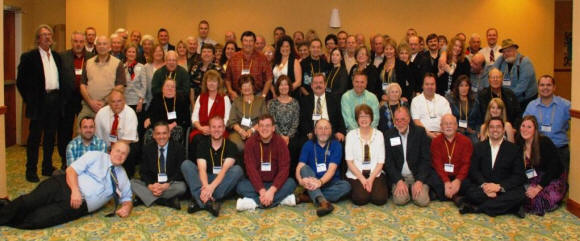
Projecting
Success:
Drive-In Owner
is the Reel Deal
Oswego
Michele Reed
April 22, 2011
Some people work a second job and call
it moonlighting.
John
Nagelschmidt ’66 means it
literally.
Since 1961 — summers as a SUNY
Oswego student, and on the side throughout a
30-year career as a teacher — Nagelschmidt
has been screening stars while working under
the stars at the Midway Drive-In. In 1987,
he bought the outdoor theatre, halfway
between Oswego and Fulton, on Route 48 in
Minetto. This year marks his 50th
anniversary at Midway.
It’s one of only a handful of drive-in
theatres left. In their 1950s heyday, 4,063
dotted the American landscape. Today there
are 374 across the country, according to the
United Drive-In Theatre Owners Association.
At their peak,
nearly 200 drive-ins thrived in New York
state. Less than 30 remain, and Nagelschmidt
has a hand in two: as sole owner of Midway
and a partner in the Black River Drive-In in
Watertown.
The outdoor theatres evoke images of
mid-century nostalgia: mom, dad and kids in
pajamas, watching Lassie movies in the
station wagon; a bulky speaker affixed to
the door; soda cups and popcorn boxes
dancing across the screen; mosquito coils
for sale at the concession stand; teenage
couples intent on acting out love scenes
like the ones on film.
 It
was into this world that Nagelschmidt
stepped in 1961. He had just been accepted
to Oswego, having won a merit scholarship,
surprising everyone — including the guidance
counselor who told him to stop kidding
around and get back to class. The Oswego
High School senior trekked up the hill to
the college and applied. It
was into this world that Nagelschmidt
stepped in 1961. He had just been accepted
to Oswego, having won a merit scholarship,
surprising everyone — including the guidance
counselor who told him to stop kidding
around and get back to class. The Oswego
High School senior trekked up the hill to
the college and applied.
Since the scholarship covered tuition but
not books, he set about to earn some money.
When a cross-country teammate who worked at
Midway told him about an opening,
Nagelschmidt took a chance. He started work
in the concession stand that summer and has
since done every job at the outdoor theatre.
Going with the flow
Nagelschmidt is an easy-going,
soft-spoken guy who takes things as they
come. An education major with certification
in earth science and physics at Oswego, he
did his student teaching at Fulton Junior
High.
 “They
were relatively pleased with me,” he says.
“When there was an opening at the high
school, they suggested I talk to the
principal and they found a spot for me over
there. I kind of went with the flow.” “They
were relatively pleased with me,” he says.
“When there was an opening at the high
school, they suggested I talk to the
principal and they found a spot for me over
there. I kind of went with the flow.”
He would go with that flow for nearly 30
years, working summers at the theatre and
teaching, first physical science and then
earth science, at G.Ray Bodley High School
until his retirement in 1995.
“Throughout college it was very
convenient, working in the summer, and
teaching was the same schedule,” he says of
his Midway job. “Sunday nights could be a
little interesting. We would run the first
two features, and then run the first one
over again if some people came in late. I
would be there until 3 a.m.” and get up
early to teach on Monday morning.
Admittedly a night owl, Nagelschmidt
still enjoys screening that late showing,
usually sending his staff home after the
second flick and running the projector
himself.
There are about 15 employees: a couple
doing maintenance, a projectionist, and a
ticket taker. The rest work the concession
stand. While Nagelschmidt was teaching, many
were his students. Now the second generation
is on board, some the children of those he
taught.

Midway's
opening night program from June 18,
1948.
Nagelschmidt himself wears a lot of
different hats at the drive-in and his weeks
are busy. He orders and picks up supplies,
chooses movies, does the advertising, keeps
the books and performs maintenance at the
theatre.
“But I never go to work,” he says. “When
it becomes work, I’m done!”
Nagelschmidt suspects that he would long
ago have tired of the routine if it were a
12-month operation, instead of the current
mid-April to early-November season. “So far
each year when spring rolls around I’m eager
to go another year,” he says. “The same can
be said for those 30 years of teaching and
the recharge that came with summers, but
that was more like work.”

On movie nights, he hangs out at the
concession stand and chats with customers.
And there are a healthy number of them.
Seasonal attendance averages 30,000, and in
the next couple of years, he expects the two
millionth customer to pass through the
gates.
Midway has a lot of regulars, many of
whom are Nagelschmidt’s former students and
their families. If they miss a weekend, they
will give him an excuse for their absence.
“All of them obviously love drive-ins,” he
says. “They go out on the road and come back
and report on the other theatres they go
to.”
Popcorn and pizza
The menu has changed quite a bit since
Nagelschmidt first tied on an apron at the
concession stand in 1961. Back then the food
was simple: hot dogs, popcorn, soda, ice
cream novelties and potato chips.

The scent of
mosquito repellant coils brings back
memories of movies under the stars.
Popcorn is still the biggest seller, but
Midway’s homemade pizza comes in a close
second. Cheese fries are big, and customers
love Midway’s own version of the Texas hot.
He’d like to expand the menu even more, but
space is limited. As it is, they use every
nook and cranny of the historic snack bar.
“We keep it simple and good,”
Nagelschmidt says. “We pride ourselves on
the fact that our food is cooked to order.
It’s good quality food.”
He’s upgraded the viewing experience,
too, taking on new technology as it becomes
available, while retaining the nostalgic
look and feel of the operation. Films run on
the original 1948 Century projectors,
modified to accommodate updated sound
technology. Since the drive-in opened, about
5,000 films have been shown, totaling nearly
245 million feet of film. That’s 46,000
miles, or twice around the earth, the former
science teacher notes.
New xenon lamps give a brighter look to
the images on the original screen, which was
expanded once in the 1950s to accommodate
the wider Cinemascope.
And since Nagelschmidt has long done away
with the bulky speakers that hung on the
windows of the car doors and sound is
broadcast on an FM channel, viewers open
their car windows and sit on the grass,
hoods of cars and backs of pick up trucks,
adding to the party atmosphere. “It’s like
tailgating, but we don’t allow alcohol,” he
stresses. “We like to keep a nice, family
atmosphere.”
Family is important to Nagelschmidt. He
lives just six miles from where he grew up,
and SUNY Oswego is a family tradition. His
son, John Nagelschmidt ’02,
was a communications major and is on staff
at WRVO-FM on campus. Daughter Heidi
Nagelschmidt M ’04 earned her master’s
degree at Oswego and teaches at Fulton,
following in her father’s footsteps.
Tech revolution
Looking to the future, Nagelschmidt
foresees challenges that could spell the end
of drive-ins unless they are able to adapt.
Instead of 18-minute reels of film, movies
will be delivered in digital format. Some
theatres have already adapted.

John
Nagelschmidt '66 is celebrating half a
century at Midway Drive-In, one of two
outdoor theatres he owns.
An even bigger issue is 3-D — is it a
phenomenon worth investing thousands of
dollars to embrace, or a passing fad?
Nagelschmidt predicts his Watertown
operation — which he co-owns with former
student Loren Knapp — will adapt more
quickly to the digital revolution.
The two rebuilt the Black River Drive-In
from the bottom up, doing all the work
themselves.
It’s a DIY work ethic rooted in
Nagelschmidt’s background. His father ran
Johnny’s Fix-It Shop in Oswego. The business
card read, “We mend anything … but broken
hearts.”
John Jr. and his brother were Johnny’s
official dismantlers — but their father
insisted they had to know how to put
anything back together. Now Nagelschmidt
puts that knowledge to use at Midway.
“Very rarely will I call in a
contractor,” he says. “I like to do things
myself. That’s probably why I got into
physics at Oswego — it kind of makes the
world go round.”
Nagelschmidt’s influences at Oswego
included Norris Goldsmith, who taught
freshman physics and had worked on the
Manhattan Project; Richard Shineman in
chemistry (“a good man”), Raymond Schneider
of geology and Bob Sykes of meteorology
(“the father of lake effect snow around
here”).
But while reminiscing is fun,
Nagelschmidt doesn’t like to live in the
past. He’s always looking ahead, attending
yearly conventions of the United
Drive-In Theatre Owners Association to learn
better techniques for running the Midway. He
already had websites (MidwayDriveIn.com
and
BlackRiverDriveIn.com) and as a result
of last year’s convention, is
now on Facebook with just shy of 5,000
“fans.”
“The key is finding a way to get the word
out,” he says, and especially with the
soldiers at Fort Drum and other young
patrons, the Web and social media are the
way to go.
It’s an irony that’s not lost on
Nagelschmidt. “Even though you think of
drive-ins as old school,” he says, “modern
technology has helped to bring them back.”

Midway
Drive-In screens plenty of
family-friendly features each summer.
Article Link
New owners plan to open
drive-in on N SR 53 soon
The Advertise-Tribune
MaryAnn Kromer
April 25, 2011
In its heyday, the Tiffin Drive-In on North SR 53 was the
place for families to go on a Friday or Saturday night and
for couples to have an inexpensive date.
This week, Rod and Donna Saunders of Liberty Center are
expecting to become new owners of the drive-in.
In 2007, the Saunders' built the Field of Dreams Drive-In
in Liberty Center, and they have been running it as a
family. Rod is a teacher at Woodmore High School in Toledo,
so he wanted a business he could operate during the summer
months. Donna works at Owens Corning in Toledo. At the time
they got started, they worried about the decline in the
economy, but those concerns have turned out to be minor.
"We've found that, no matter how bad the economy gets,
people still need their escape from their own personal
reality. Movies are an inexpensive way for people to
escape," Donna said.
She said Rod had looked into buying a second site in
Gibsonburg but learned it would not be available. Then
earlier this year they heard the Tiffin Drive-In was not to
be re-opened for the season.
The Barrs, who live in the Cleveland area, said they were
retiring and selling their theater businesses around the
state, including the one in Tiffin. Rod said Norman was
making arrangements to put the Tiffin theater on the market.
Online, Rod found a short video of the property, but he had
not been there in person. Even so, he expressed interest in
its purchase.
"I knew where Tiffin was, but I had no idea how to get
here," Rod said.
Back in Ohio, the couple visited the site in person and
brought in other people to assess its condition. Rod said
trees were growing in front of the screen, and he saw the
need to modernize the restrooms. With enough time and money,
he felt it could be brought up to code.
The Saunders made an offer and the Barrs accepted.
In March, Rod received permission to start cleaning up
the grounds, even though the closing had not occurred.
"We've had people stop by because they've noticed people
out working. They pull in and say, "What are you doing?' ...
Once they find out we're going to keep it a drive-in and not
destroy it, they are really excited," Donna said.
Rod is working with commercial inspectors from Richland
County to make sure the wiring, plumbing and other systems
are adequate.
A contractor already has been secured to repair and paint
the large screen. The Saunders and family members plan to do
much of the work themselves.
"We'd love to be open by Memorial Day, at least with the
first screen. We're planning on adding a second screen, and
we're hoping to have that second screen up by June," Donna
said.
"Our plans are, first and foremost, to put a great
picture on the screen ... but we also want to make it look
appealing, a safe place for families to come and spend the
evening," Rod said.
If constructed, the second screen would measure about 45
feet wide by 20 feet high and serve 90-100 vehicles.
With two screens, the Saunders would be able to have a
different first-run movie every week. During the first week,
each film would run on the main screen and then move to the
secondary screen the second week. Rod said movies that
attract a large audience could run on the larger screen both
weeks. Patrons would have more options for viewing new
releases.
"When you have first-run movies, the distributors require
that you keep that movie for two weeks, sometimes three
weeks," Donna explained. "Every weekend, then, we will have
four movies showing, because we have double features."
The Tiffin theater is being renamed Field of Dreams
Drive-In-Tiffin. The new name is to let people know it is
under new management with ties to the Saunders' original
drive-in. Donna said the pricing and food menu will be
similar at both locations. Children under age 5 will be
admitted free, and food at the concessions stand will be
made from scratch.
The house on the Tiffin site is to be refurbished and
Denton Saunders, the couple's oldest child, is to live there
during the season to manage the theater. He is a junior at
Bowling Green State University, studying to be a teacher.
Experienced staff from the Liberty Center theater are to be
brought in to do quality control and train a few new hires
in Tiffin.
In doing informal surveys, the couple learned that area
residents had stopped coming to the Tiffin drive-in because
of its decrepit condition and poor service. The new owners
want to treat customers well to keep them coming back. The
tactic has worked so far.
"We have found that word-of-mouth advertising is our best
advertising. Once people find out about us and try us, they
just tell everybody they know about us. We have grown by
leaps and bounds," Donna said.
"One of us plans to be here every night," Rod said.
The Liberty Center Field of Dreams Drive-In opened Friday
night with "Ringo" and "Hop."
Article Link
Bro, Go Retro At These 7 Drive-In Theaters
AOL Travel
Alison Lowenstein
March 31, 2011
Long gone are the days of watching movies at a
drive-in or listening to films via portable radio.
Or are they? In a world of Netflix and multiplexes,
the drive-in movie theater is a major piece of
cinema history that thankfully didn't go the way of
CinemaScope. Located on country fields or parking
lots on the outskirts of cities, a handful of mostly
family-owned theaters still exist.
Maybe it's the allure of the 1950s, when life wasn't
filled with smart phones and social media, but folks
are flocking back to drive-in theaters. What's the
allure? Documentary filmmaker April Wright, working
to complete "Going Attractions: The Rise and Fall of
the American Drive-in Movie Theater," seeks to
answer that question. She traveled to every state
(except Alaska) to visit almost 500 open, abandoned,
and former sites of drive-ins to make the film.
"Drive-ins were originally a family experience, and
today it's returned to that idea," Wright told AOL
Travel. "Not to mention it's inexpensive."
From a Midwestern theater that's open year-round to
a drive-in movie theater sitting on the outskirts of
a major US city, these drive-ins are worth a visit.
Bengies Drive-In,
Baltimore
Open seasonally, this drive-in is just a short trip
from downtown Baltimore. Open since 1956, Bengies
has the biggest screen in the country, with up to
three films shown a night on their one screen. Like
most drive-ins, Bengies tries to show family films
during the first screening of the night.
Ford Drive-In,
Dearborn, Michigan
Also known as the Ford Wyoming, the five-screen
theater has been open since the 1950s and continues
to show first run flicks. Unlike most drive-in movie
theaters, which operate on a seasonal basis, this
drive-in is open year-round and it's located in the
heart of the Midwest, known for extreme winters.
During the winter, the theater only operates on
weekends.
Shankweilers,
Orefield, Pennsylvania
Open since 1934, Shankweilers is the oldest drive-in
in America. Roughly an hour's drive from
Philadelphia, the drive-in has one screen that shows
double feature. Check out nearby
Becky's Drive-In
, which has 2 screens and also offers pony
rides.

Corral Drive In
Corral
Drive-In,
Guymon, Oklahoma
This 200-car drive-in, closed in the 1980s, sat
vacant until it was restored and reopened in 2009.
Kids will love the arcade, playground and assortment
of inflatable bouncers (including an 18 foot dump
truck slide). For overnighters, the theater recently
opened an adjacent RV park.
Warwick Drive-In,
Warwick, NY
Located only ninety minutes from New York City,
Warwick is known more for its apple orchards and
charming main street. But the town also offers a
three-screen, double-feature drive-in that was
opened in 1950. The theater is open seasonally from
March through October.
Wellfleet Drive-In,
Wellfleet, Massachusetts
The only drive-in on Cape Cod, the theater is
consistently filled with visitors all summer. Built
in 1957, the theater runs double features of first
run films on their one screen. The drive-in has an
ice cream parlor, a mini-golf course and playground
(it also doubles as a flea market on select days).
Delsea, Vineland, New Jersey
Even though the state was home to the first
drive-in, the Delsea, built in the 1940s, is New
Jersey's sole reminder of times gone by. In 2003, it
was restored and now has two screens that show
current films seasonally. The Delsea also offers
something others don't: a snackbar with an extensive
menu of Atkins-friendly choices.
Article Link

Courtesy photos
A modified pole barn is being used by
the Huntington Drive-In to set up a
second screen.
Until temps hit the mid-50s last week,
this was shaping up to be one of the
most discontented winters of all the
winters of our discontent. Should
temps dip back down to subzero levels,
we will have some gloriously summery
news to sustain us: The owners of the
Huntington Drive-In theater, John and
Nellie Detzler, are putting the
finishing touches on a second screen.
This development comes a year after
those same owners indicated that they
would be retiring soon.
It’s not as contradictory as it might
seem. John Detzler says it was his plan
all along to install a second screen.
But fate kept intervening.
“Life happens,” as he puts it.
Playground and concession stand
renovations were a priority after the
Detzlers bought the property a decade
ago.
And then in 2005, a windstorm knocked
down the newly refurbished main screen
and that set things back even more.
As Detzler tried to secure financing
for the second screen, he looked for
ways to do it more cheaply than the
standard steel model.
His initial idea was to attach the
screen to a tower of stacked cargo
containers but the city put the kibosh
on that.
Then he heard tell of a new trend in
the drive-in movie biz (such as the biz
and new trends in it are these days):
pole barns.
Some theater operators who wanted to
add an economical second screen were
attaching them to modified pole barns.
Detzler says he was able to add a
barn, screen and second projection booth
to his property for what it would have
cost to build a traditional steel
screen.
The Detzlers bought no new land for
the project.
They are merely splitting up the
existing space: patrons will just point
their cars at whatever screen is showing
the movie they came to see.
“A lot of (theaters) do this because
it is very rare to have a sellout,”
Detzler says. “We usually don’t come
close to selling out.”
This is far from a risky venture. In
fact, it will ease some of the
frustrations that are unique to the
drive-in movie business.
In the Huntington Drive-In’s
single-screen days, Detzler could not
show all of the movies he wanted to
show.
Each new summer blockbuster comes
with a two- or three-week guarantee,
Detzler says, meaning that he is
prohibited from swapping that film out
for another during the agreed-upon
period. Neither can he pair it with a
film from another studio, he says.
With big films opening every weekend
in the summer, Detzler used to have to
pick and choose.
“Last year we had to pass on ‘Karate
Kid,’ ” he says. “We never did end up
playing it, and it was a shame. It was a
good PG-rated family movie.”
Now, Detzler can shift a movie in its
second week of release to his second
screen and open a new movie on the main
one. “Cars 2” and “Transformers 3” open
within a week of each other this summer,
Detzler says, and in the past he would
have had to pass on “Transformers 3” or
show it at a much later date. Now he can
bring both films to the theater.
The new scheme of things will make
the Huntington Drive-In theater much
more profitable and, therefore, more
attractive to potential buyers.
Yes, the Detzlers are still thinking
about retirement. But Detzler says he
would never consider just closing the
theater to achieve it.
“No, I certainly wouldn’t do that,”
he says.
Detzler has spent his entire adult
life as an owner and projectionist in
the movie exhibition biz, mostly in Lake
County.
He says he started to consider the
purchase of a drive-in when projectors
became more automated and the job of
projectionist was handed over to
untrained concessions workers and
ushers.
In this age of digital movies, it is
easy to forget what a brouhaha this
caused among union projectionists, not
to mention cinephiles who quickly grew
tried of unfocused and badly framed
movies.
The Huntington Drive-In is still all
celluloid and there will always be a man
on site who knows his way around a
projector – the way Itzhak Perlman knows
his way around a fiddle.
Detzler says that whoever buys the
Huntington theater has to be a special
kind of person, perhaps someone who
fully appreciates the enduring
specialness of drive-ins.
“The buyer has to be someone who
doesn’t mind giving up every weekend all
summer long,” he says. “It is something
that they really have to enjoy doing,
especially on holiday weekends. That’s
what the job is, because that’s what
people are coming here for, to enjoy
themselves.”
As hard and exhausting as the job can
be sometimes, Detzler says he still gets
a thrill walking the perimeter at dusk.
“Yeah, I get the show started … and
walk by the cars up front. Kids are
there playing and families have blankets
spread out. Moms and dads are sitting on
lawn chairs and you just know you are
doing something different. It can be
very satisfying and rewarding.
“Just not necessarily monetarily,” he
says with a laugh. “But sometimes
monetarily!”
Article Link
Drive-Ins Enter the Digital Age
Digital Cinema Report
Nick Dager
August 13, 2010
For more than half a century, the Spud Drive-In has been
a local landmark in Diggs, Idaho. Last month, with
screenings of Despicable Me and Robin Hood, it became
America’s first true digital drive-in. While other
outdoor theatres have used digital projectors to show
DVDs to large outdoor audiences, Spud is the only
drive-in to date to actually employ digital cinema
projection and surround sound audio. They plan to
install 3D technology this month.
When Spud made the decision to go digital, timing was of
the essence. Since the drive-in movie season is
relatively short in Idaho, it was important to get a
projector online quickly for the July opening. Barco was
able to provide a projector within a few weeks.
“We looked at a lot of options, but the Barco projector
was the ideal fit for the drive-in movie environment
because of its low power requirements, liquid cooling,
and of course, incredible image quality and reputation
for reliability,” says Spud's chief operating officer,
Keith Zednik. “It's just amazing – like nothing I've
ever seen before. With the Barco projector, we'll be
able to continue for another 50 years, not only as a
movie exhibitor, but as a total entertainment provider.”
Spud plans to offer alternative content packages to
customers, including wedding receptions, non-profit,
club and community functions, and even live simulcast
sports events and concerts.
John Fithian, president of the National Association of
Theatre Owners, says, “Drive-ins are an important part
of the theatre business. At NATO, we are pleased to see
Barco providing a digital projector solution capable of
illuminating drive-in screens. We are confident that
drive-ins will continue to flourish in the digital age
and congratulate the Spud on being the first of many
drive-ins to offer their customers the digital
experience.”
United Drive-In Theatre Owners Association president
Paul F. Geissinger says, “We congratulate the Spud Drive
In and their digital partner Barco in providing their
patrons and the motion picture industry with the first
digital projection system at a traditional drive-in
theatre. This is an historic event for drive-in
theatres, a true icon of Americana, which we view as
only the beginning of what will be a huge transition to
the digital age by drive-in motion picture theatres.”
 Spud
Drive-In Theater is one of the last American drive-in
theaters, and one heck of a roadside attraction. It is
most famous for Old Murphy, a 1946 Chevy cab-over truck
that carries a two-ton potato. Old Murphy sits in front
of the screen and has been photographed by travelers
from all over the world. Spud
Drive-In Theater is one of the last American drive-in
theaters, and one heck of a roadside attraction. It is
most famous for Old Murphy, a 1946 Chevy cab-over truck
that carries a two-ton potato. Old Murphy sits in front
of the screen and has been photographed by travelers
from all over the world.
The Spud was built in the spring of 1953 by Ace Wood and
opened its doors that July. It was a state-of-the-art
facility back then, using mono-speakers that hung in the
windows to broadcast the audio and twin carbon ark real
to real projectors. Today, the audio is transmitted
through FM stereo. Some things have been updated at the
drive-in, but the spirit remains the same.
The exhibitor launched its digital premiere with a
double feature on Friday, July 9th, showing Despicable
Me and Robin Hood. Attracting hundreds of moviegoers
from around the county, Spud enjoyed its largest crowd
of the season, breaking records for its Monday night
“$15 Per Car” promotion.
“The image quality was picture perfect, and it was so
easy to use – no technical problems at all. The Barco
has made my life a million times easier,” says Zednik.
Roger Bockert, owner of Heartland Theatre Services who
installed the new system, says, “If anyone out there is
still uncertain about putting digital in a drive-in,
Spud's experience will put their mind at ease. The
results have been even better than expected as far as
picture quality, light output, and reliable image.”
In business for more than 20 years, Bockert has
installed hundreds of digital projectors throughout the
Midwest in traditional theatres, and looks forward to
additional business in the drive-in market based on the
success of Spud's deployment.
“We're honored to work with Spud Drive In to pioneer
the first true digital cinema drive-in theatre. This
opportunity demonstrates the power and versatility of
Barco's products. We applaud Spud's entrepreneurial
spirit and desire to extend their entertainment options
with alternative content, which will showcase the Barco
projector's features and delight patrons for years to
come,” says Todd Hoddick, vice president, digital cinema
North America.
Article Link
First digital cinema
drive-in in U.S. selects Barco
Film Journal International
July 27, 2010
Barco deployed its digital-cinema projectors at Spud Drive
In in Driggs, Idaho, making the venue the first “true”
digital drive-in in America.
While other outdoor theatres have utilized digital
projectors to show DVDs to large outdoor audiences, Spud is
the only drive-in to date to actually employ digital-cinema
projection and surround sound, with 3D technology planned
for August showings.
John Fithian, president of the National Association of
Theatre Owners, commented, “Drive-ins are an important part
of the theatre business. At NATO, we are pleased to see
Barco providing a digital projector solution capable of
illuminating drive-in screens. We are confident that
drive-ins will continue to flourish in the digital age and
congratulate the Spud on being the first of many drive-ins
to offer their customers the digital experience.”
United Drive-In Theatre Owners Association (UDITOA)
president Paul F. Geissinger stated, “We congratulate the
Spud Drive In and their digital partner Barco in providing
their patrons and the motion picture industry with the first
digital projection system at a traditional drive-in theatre.
This is an historic event for drive-in theatres, a true icon
of Americana, which we view as only the beginning of what
will be a huge transition to the digital age by drive-in
motion picture theatres.”
“We looked at a lot of options, but the Barco projector was
the ideal fit for the drive-in movie environment because of
its low power requirements, liquid cooling, and of course,
incredible image quality and reputation for reliability,”
commented Spud’s chief operating officer, Keith Zednik. Spud
plans to offer alternative-content packages to customers,
including wedding receptions, nonprofit, club and community
functions, and even live simulcast sports events and
concerts.
The exhibitor launched its digital premiere with a double
feature on July 9, showing Despicable Me and Robin Hood.
Roger Bockert, owner of Heartland Theatre Services who
installed the new system, commented, “If anyone out there is
still uncertain about putting digital in a drive-in, Spud’s
experience will put their mind at ease. The results have
been even better than expected as far as picture quality,
light output and reliable image.”
Article Link
The
United Drive-In Theatre Owners Association (UDITOA)
Announces its 13th Annual
“UNOFFICIAL” Fall Gathering. November 11, 12 &
13, 2011
Fun for ALL Fellow Drive-In Owners, Operators and Managers, this
is a traditional, mainly social event for our organization and
allows non member drive in theatres to participate and meet
other drive-in owners, operators, managers and their guests.
INVITATIONS are being sent out the week of October 17, via US
Mail to all known drive-in theatres, members or not. If you
do not receive an invitation in the mail by October 24,
please email us through this website choosing Administrative
Secretary as the option in the drop down box. If you are a
drive-in theatre owner and have never received mail form our
organization and wish to be on our US Mailing List, please
contact us through this website as per the instructions above.
You DO NOT need to be a member to attend the Fall Gathering IF
you qualify for membership. To see if you qualify click here.
Some details of this event:
We will meet at the theatre on Friday night, November 11th
at 6pm for dinner and social time. Saturday’s events are local,
and mostly social, however there will be a CBG (Cinema Buying
Group) member to member discussion with the latest updates
specific to Drive-in Theatres lead by UDITOA President John
Vincent. John will also speak to the whole group on the Digital
rollout in general plus other industry issues. All persons
interested in making this conversion by the deadline, which has
been extended to September, 2012 are encouraged to attend this
gathering! On Sunday, November 13th at 10am
until about 2pm, GDC Technology (server manufacturer) will offer
a one session certification (training) course on GDC servers
(Free) in the Hotel conference room. PLEASE follow the
instructions on the invitation for RSVP to be included in these
events.
Archived
News
Copyright © - United
Drive-in Theatre Owners Association, Inc.
|
 |
 |
|
|
| |












 “The
drive-in theatre not
only remains a time
honored American icon,
but in a down economy
still offers the best
value available for
family entertainment,”
said John Vincent, Jr.,
president of the UDITOA.
“The
drive-in theatre not
only remains a time
honored American icon,
but in a down economy
still offers the best
value available for
family entertainment,”
said John Vincent, Jr.,
president of the UDITOA. Technical
and financial challenges
were reviewed, according
to Vincent, who added
that several digital
projection manufacturers
were present, some
providing hands on
demonstrations.
Technical
and financial challenges
were reviewed, according
to Vincent, who added
that several digital
projection manufacturers
were present, some
providing hands on
demonstrations.